









Pronunciation: con-KAH-veh-NAY-tuhr
Meaning: Cuenca hunter
Author/s: Ortega, Escaso and Sanz (2010)
Synonyms: None known
First Discovery: Cuenca, Spain
Acta Ordinal: #751
Concavenator corcovatus
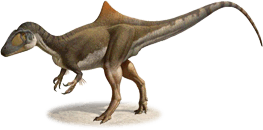
Discovered at Las Hoyas and dubbed "the hunchback hunter of Cuenca", Concavenator was buried in "Konservat-Lagerstätten" beds which are renowned for their extraordinarily well-preserved fossils, often with soft tissue. Sure enough, its skeleton is virtually complete and beautifully preserved, with features that clearly show it is a primitive member of Carcharodontosauria, the "shark-toothed lizards" that dominated the area south of the equator (Gondwana) during the Early Cretaceous. And while hardly in the same league as its hulking brethren, some of which out-massed Tyrannosaurus, Concavenator trumped them all with what looks for all the world like a shark-like dorsal fin too.
Besides posing a potentially perilous obstacle for amorous males of the species, this high, pointed protuberance, formed by the elongated spines of two vertebrae just in front of its hip, may have supported an energy-storing hump like a camel, or a sail for heat regulation, or may have just been a good old-fashioned accessory for species recognition which is normally a job for fancy dan head crests. Funnily enough, the spined vertebrae look suspiciously similar to the only confirmed remains of an enigmatic English theropod known as Becklespinax, which has a tangled history spanning well over 100 years. But Concavenator also has features that, until its discovery, were unknown amongst its kind.
The ulna bone in the forearm of Concavenator features a row of bumps that were initially interpreted as "quill knobs"—or follicle anchor points—which is a feature only seen in critters known to have had large feathers, or at least bristly, quill-like, "protofeathers". We know that some ornithischians had such structures, but the only theropods to have 'em are those from the coelurosaur side of the theropod track. Convavenator belongs to the other branch of theropods, the carnosaurs, who haven't had a sniff of feathers, quills or even fluff, apart from a speculatively feathered allosaurid illustration by Greg Paul some years ago, and unfortunately that may still be the case.
Although other dinosaurs from the same area have been beautifully preserved with them, no feathers were preserved on or even close to Concavenator, and after closer inspection, several experts suspect those bumps were tendon attachments that were anchoring nothing more than muscle, because of their placement closer to the front part of the forearm than to the rear, which is where they are in birds and bird-like dinosaurs. However, we do have an idea of what other parts of its body were covered in, thanks to scale impressions on the underside of its tail, and podetheca—a scaly covering found on the legs and feet of birds and lizards that palaeontologists always assumed dinosaurs had, but which is rarely preserved.
Besides posing a potentially perilous obstacle for amorous males of the species, this high, pointed protuberance, formed by the elongated spines of two vertebrae just in front of its hip, may have supported an energy-storing hump like a camel, or a sail for heat regulation, or may have just been a good old-fashioned accessory for species recognition which is normally a job for fancy dan head crests. Funnily enough, the spined vertebrae look suspiciously similar to the only confirmed remains of an enigmatic English theropod known as Becklespinax, which has a tangled history spanning well over 100 years. But Concavenator also has features that, until its discovery, were unknown amongst its kind.
The ulna bone in the forearm of Concavenator features a row of bumps that were initially interpreted as "quill knobs"—or follicle anchor points—which is a feature only seen in critters known to have had large feathers, or at least bristly, quill-like, "protofeathers". We know that some ornithischians had such structures, but the only theropods to have 'em are those from the coelurosaur side of the theropod track. Convavenator belongs to the other branch of theropods, the carnosaurs, who haven't had a sniff of feathers, quills or even fluff, apart from a speculatively feathered allosaurid illustration by Greg Paul some years ago, and unfortunately that may still be the case.
Although other dinosaurs from the same area have been beautifully preserved with them, no feathers were preserved on or even close to Concavenator, and after closer inspection, several experts suspect those bumps were tendon attachments that were anchoring nothing more than muscle, because of their placement closer to the front part of the forearm than to the rear, which is where they are in birds and bird-like dinosaurs. However, we do have an idea of what other parts of its body were covered in, thanks to scale impressions on the underside of its tail, and podetheca—a scaly covering found on the legs and feet of birds and lizards that palaeontologists always assumed dinosaurs had, but which is rarely preserved.
(Hump-backed Cuenca hunter)Etymology
Concavenator is derived from "Conca" (Latin name for the Spanish province of Cuenca) and the Latin "venator" (hunter). The species epithet, corcovatus, is also Latin and means "hump-backed". ZooBank registry: urn:lsid:zoobank.org:act:8FFADAAA-8CCE-4D28-9095-8165A825F55F.
Discovery
Concavenator was discovered in Konservat-Lagerstätte beds within the Calizas de La Huérguina Formation at Las Hoyas, La Cierva township, Cuenca, Spain.The holotype (MCCM-LH 6666, housed at the Museum of Science in Castilla-La Mancha, Spain) is an almost complete and exquisitely preserved skeleton.


