




dinochecker
Welcome to our ERLIKOSAURUS entry...
Archived dinosaurs: 1221
fb twit g+ feed
Dinosaurs from A to Z
Click a letter to view...
A B C D E F G
H I J K L M N
O P Q R S T U
V W X Y Z ?

ERLIKOSAURUS

a plant-eating therizinosaurid theropod dinosaur from the Late Cretaceous of Mongolia.
Pronunciation: ER-lik-o-SOR-us
Meaning: Death-God lizard
Author/s: Perle (2001)
Synonyms: Erlicosaurus andrewsi
First Discovery: Ömnögovi, Mongolia
Discovery Chart Position: #277

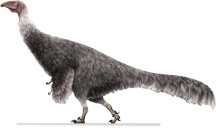
Erlikosaurus andrewsi

Not too long ago, the profile of theropod dinosaurs was simple: they were predators and carnivores and, as such, were mostly sleek and agile with lots of sharp pointy teeth. However, a branch of theropods called therizinosaurs were just freaky and deviated from the theropod blueprint in so many ways. They had wide hips and a backwards-pointing ornithischian-like pubis to make space for a pot belly, their jaws sport features that suggest the presence of a beak, but they were not birds, their hands were adorned with huge scythe-like claws that they didn't use to rent prey asunder, and their teeth were blunt and leaf-shaped. Some, like Erlikosaurus, had a well-developed sense of smell, hearing and balance, which are traits suited to agile hunters. But Erlikosaurus, and, in fact, all therizinosaurs, were herbivorous and somewhat sloth-like, and the only things they hunted were plants.
(Chapman's Mongolian Death God Lizard)Etymology
Coined by Perle and Barsbold in 1980, Erlikosaurus is derived from "Erlik" (the god of the dead in Mongolian mythology) and the Greek "sauros" (lizard), while the species epithet, andrewsi, honors palaeontologist Roy Chapman Andrews who led the American Asiatic expeditions in 1922-1930. All straight forward, so far. But then Perle tried to sneakily republish the same specimen under the Latinised name Erlicosaurus (with a "c") the following year as if it were new. No-one was fooled, though, and the original name (with a "k") is the one that is widely regarded as valid.
Discovery
The remains of Erlikosaurus were discovered at Baysheen Tsav (aka Baishin, Baynshin, or Bainshin, Tsav) in the Bayan Shire Formation (aka Baynshire Svita, Bayan Shireh Svita, Bayan Shiren Svita, Bayanshiree Svita, Bayn-shirenskaya Svita), Ömnögovi (Southern Gobi) Aimag (Province), Mongolia, during a Soviet-Mongolian expedition in 1972. The holotype (PST No. 100/111) includes the only known three-dimensionally preserved and nearly complete therizinosaurian skull, a left humerus (upper arm bone), a pes (foot) with unusually long and slender claws, and some fragmentary cervical (neck) vertebrae. In 2014, its skull was CT scanned by Stephen Lautenschlager, Emily Rayfield, Altangerel Perle, Lyndsay Zanno and Lawrence Witmer then digitally prepared, disarticulated, and restored to reveal its inner workings.
In 2010, Greg Paul accused Erlikosaurus of being the same critter as Enigmosaurus, which was also found in the Baynshire Formation. But the pair are currently uncomparable, as the latter is known only from an "enignatic" hip, while a hip belonging to the former has yet to be discovered.
Estimations
Timeline:
Era: Mesozoic
Epoch: Late Cretaceous
Stage: Cenomanian-Turonian
Age range: 99-89 mya
Stats:
Est. max. length: 4.5 meters
Est. max. hip height: ?
Est. max. weight: 500 Kg
Diet: Herbivore
References
• Perle A (1979) "Segnosauridae: novoe semejstvo teropod iz pozdnego mela Mongolii" [Segnosauridae: a new family of Theropoda from the Lower Cretaceous of Mongolia]. Sovmestnaya Sovetsko–Mongol’skaya eskpeditsia, Trudy [Joint Soviet-Mongolian Expedition, Transactions]: 45-55. (English translation by Catherine Siskron and Samuel P. Welles / Polyglot.)
• Barsbold R and Perle A (1980) "Segnosauria, a new infraorder of carnivorous dinosaurs". Acta Palaeontologica Polonica, 25(2): 187-195.
• Perle A (1981) "Novyy segnozavrid iz verkhnego mela Mongolii" [New Segnosauridae from the Upper Cretaceous of Mongolia]. In Barsbold, Vorobyeva, Luvsandanzan, Tatarinov, Trofimov, Reshetov and Shishkin (eds.) "Sovmestnaya Sovestsko-Mongol’skaya Paleontologicheskaya Ekspeditisiya, Trudy [Mongolian Vertebrate Fossils. Joint Soviet-Mongolian Expedition, Transactions]", 15: 50-59. (English translation by Catherine Siskron and Samuel P. Welles / Polyglot.)
• Zanno LE (2010) "A taxonomic and phylogenetic re-evaluation of Therizinosauria (Dinosauria: Maniraptora)". Journal of Systematic Palaeontology, 8(4): 503-543. DOI: 10.1080/14772019.2010.488045
• Paul GS (2010) "The Princeton Field Guide to Dinosaurs". Page 159.
• Lautenschlager S, Rayfield EJ, Altangerel P, Zanno LE and Witmer LM (2012) "The Endocranial Anatomy of Therizinosauria and Its Implications for Sensory and Cognitive Function". PLoS ONE 7(12): e52289. DOI: 10.1371/journal.pone.0052289
• Lautenschlager S (2015) "Estimating cranial musculoskeletal constraints in theropod dinosaurs". Royal Society Open Science 2 (11): 150495. DOI: 10.1098/rsos.150495
• Lautenschlager S, Witmer LM, Altangerel P, Zanno LE and Rayfield EJ (2014) "Cranial anatomy of Erlikosaurus andrewsi (Dinosauria, Therizinosauria): new insights based on digital reconstruction". Biocontrol Science and Technology, 34(6): 1263-1291. DOI: 10.1080/02724634.2014.874529
• Cau A (2020) "The body plan of Halszkaraptor escuilliei (Dinosauria, Theropoda) is not a transitional form along the evolution of dromaeosaurid hypercarnivory". PeerJ 8: e8672. DOI: 10.7717/peerj.8672
Email    Facebook    Twitter    Reddit    Pinterest
Time stands still for no man, and research is ongoing. If you spot an error, or want to expand, edit or add a dinosaur, please use this form. Go here to contribute to our FAQ.
All dinos are GM free, and no herbivores were eaten during site construction!
To cite this page:
Atkinson, L. "ERLIKOSAURUS :: from DinoChecker's dinosaur archive".
›. Web access: 06th Mar 2026.
  top