









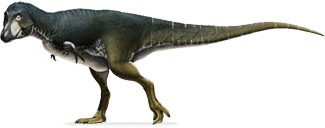
Pronunciation: LY-thro-nax
Meaning: King of gore
Author/s: Loewen et al. (2013)
Synonyms: None known
First Discovery: Utah, USA
Acta Ordinal: #869
Lythronax argestes
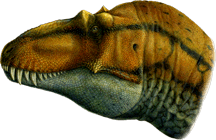 On face value, literally, 'cos that's almost all the remains we have, Lythronax is all tyrannosaurid, with its deep, rounded and robust snout, an expanded rear of the skull which allowed for fully forward-pointing eyes and thus binocular vision, and massive bone-crushing teeth. These features were nothing unusual in late-living tyrannosaurids that appeared some 70 million years ago, but what made palaeontologists shout "OMG" (or words to that effect) is that the "King of gore" was discovered in Utah's Mid-Campanian-aged Wahweap Formation so pushed the origin of tyrannosaurid-skull-robustness back some 10 million years into a time when the only tyrant lizards were thought to be the tyrannosauroids, and they were meek and mild by comparison.
Lythronax inhabited Laramidia, a western landmass seperated from Appalachia to the east by the Western Interior Seaway, a shallow sea that flooded central North America during the Late Cretaceous. This isolation and, in fact, the isolation of certain parts of Laramidia from others as sea levels and great mountains rose, forced its inhabitants to evolve in their own distinct ways, not unlike "Darwin's finches" of the Galapagos islands. Furthermore, as the oldest known tyrannosaurid, Lythronax prompted palaeontologists to peddle a Laramidian origin for its ilk, meaning the similarly robust Asian forms, such as Tarbosaurus, didn't rise in Asia at all but merely sauntered over there via land bridges as sea levels began to fall.
Because Lythronax and a branch of narrow, long and shallow-skulled tyrannosaurids like Gorgosaurus evolved in tandem around 80 million years ago on the same continent, palaeontologists fully expect this area to yield an even older critter, perhaps 82-90 million years old, that will shake the tyrant lizard family tree to its roots by being the ancestor of both lineages and sport features somewhere between the two.
(ARGESTES' KING OF GORE)Etymology
Lythronax is derived from the Greek "lythron" (gore) and "anax" (king).
The species epithet (or specific name), argestes (ar-GES-tees), is named for the southwest wind in Homers Oddysey in reference to the geographic location of the specimen within North America.
ZooBank registry: urn:lsid:zoobank.org:act:DE2997BB-1D2B-47C2-A341-80D6FCEFDB34.
Discovery
The remains of Lythronax were discovered near the hilariously-named "Nipple Butte" (yes, we know, it's childish) in the Wahweap Formation (lower middle member), Grand Staircase-Escalante National Monument, Kane County, southern Utah, USA, by Scott Richardson of the BLM (Bureau of Land Management) in 2009. The holotype (UMNH VP 20200) is a partial skull.


