


Pronunciation: REET-oh-SOR-us
Meaning: Rhoetos lizard
Author/s: Herber Longman (1926)
Synonyms: None known
First Discovery: Queensland, Australia
Acta Ordinal: #153
Rhoetosaurus brownei
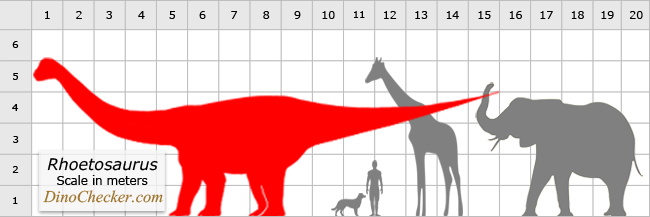
Rhoetosaurus, often mispelled Rhaetosaurus or Rheteosaurus, is a sauropod—a rotund, four-legged plant eating dinosaur—and hails from the Jurassic Eurombah Creek at Taloona Station. It was the first "big" dinosaur to be discovered in Australia and represents the most complete of only two pre-Cretaceous dinosaurs (the other is Ozraptor) known from the merry old land of Oz. It was also thought to be Middle Jurassic in age, but was dragged forward to the earliest Late Jurassic by Todd et al. in 2019 after zircon dating its sandstone matrix.
Its remains were dug up from Durham Downs in two parts: a series of tail vertebrae in 1924 and the hip region in 1926, and that's when Herber Albert Longman of the Queensland Museum named Rhoetosaurus and assigned it to Cetiosauridae, just because most early sauropods were. He was convinced this area was choc-a-bloc with fossils just waiting to be excavated, and sure enough Mary Wade, Alan Bartholomai, Tom Rich, Anne Warren, Zhao Xijin, Ralph Molnar and others have all visited the site since 1975 and discovered tons of material, most if not all belonging to a single individual.
Robust limbs and an extremely deep and swiftly-tapering tail, which some experts suspect was adorned with a bony club, suggest Rhoetosaurus was a heavy lizard. Funnily enough, after studying previously undescribed remains in 2012, Nair and Salisbury recovered Rhoetosaurus as a member of Gravisauria—literally "the heavy lizards"—though we don't know how heavy because as-yet we've hardly had a sniff of remains that don't belong to its rear end.
Its remains were dug up from Durham Downs in two parts: a series of tail vertebrae in 1924 and the hip region in 1926, and that's when Herber Albert Longman of the Queensland Museum named Rhoetosaurus and assigned it to Cetiosauridae, just because most early sauropods were. He was convinced this area was choc-a-bloc with fossils just waiting to be excavated, and sure enough Mary Wade, Alan Bartholomai, Tom Rich, Anne Warren, Zhao Xijin, Ralph Molnar and others have all visited the site since 1975 and discovered tons of material, most if not all belonging to a single individual.
Robust limbs and an extremely deep and swiftly-tapering tail, which some experts suspect was adorned with a bony club, suggest Rhoetosaurus was a heavy lizard. Funnily enough, after studying previously undescribed remains in 2012, Nair and Salisbury recovered Rhoetosaurus as a member of Gravisauria—literally "the heavy lizards"—though we don't know how heavy because as-yet we've hardly had a sniff of remains that don't belong to its rear end.
(Browne's Rhoetos lizard)Etymology
Rhoetosaurus is derived from "Rhoetus" (a Titan in Greek Mythology) and the Greek "sauros" (lizard).
The species epithet, brownei, honors Durham Downs Station manager Arthur Browne.
Discovery
The first remains of Rhoetosaurus were discovered in the Hutton Sandstone Formation (aka Walloon Coal Measures) at Eurombah Creek, Taloona Station (originally part of Durham Downs Station), 60 km NNE of Roma, Queensland, Australia, in 1924.
A holotype was never assigned but the hypodigm (all known remains), catalogued as "QM F1695", includes 40 vertebrae, mainly from the tail but a few from the hip and neck, associated arches, pubic bones, elements from the right hind limb, and various odds and ends. Apparently, several tons of block containing bones have been excavated from the same site but have yet to be prepared.