









Pronunciation: SIEN-o-soh-ROP-tuh-riks
Meaning: Chinese dinosaur wing
Author/s: Ji and Ji (1996)
Synonyms: None known
First Discovery: Liaoning, China
Acta Ordinal: #421
Sinosauropteryx prima
The first specimen of Sinosauropteryx—a small predatory dinosaur related to, but smaller and younger than, Compsognathus—was found on two separate stone slabs by a farmer named Li Yumin whilst prospecting around Liaoning Province in 1996. By their very nature, farmers are thrifty, so old Yu flogged them to two seperate museums; the National Geological Museum in Beijing and the Nanjing Institute of Geology and Paleontology, thereby maximizing their worth. Such was their worth, in fact, Chinese authorities initially barred photographs of them from publication. But you can't keep such a jaw-dropping discovery to yourself, and they learned how to share in the end.
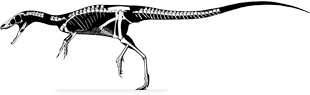
When the two Jis described Sinosauropteryx in 1996, it was heralded as the first non-bird dinosaur to preserve evidence of feathers, but not by everyone. A barrage of criticism arrived via the "dinosaurs-can't-be-feathered" brigade, some of whom hadn't even seen the specimen, so palaeontologists began referring to its primitive feathers as "integumentary filamentous structures". However, using the same technique as used on fossilized birds, Sinosauropteryx also became the first dinosaur to be color decoded, at least partially, when paleontologists identified fossilized melanosomes, the pigment - bearing organelles that give modern birds their feather colour. The presence of these cells alone proved that the tail of this critter, 64 vertebrae long, and proportionately the longest of any theropod, was covered with wispy feathers rather than decaying collagen fibers as some suspected. And they also showed that, color-wise, its feathered tail was orange, white and stripey.
Like our flying feathered friends, the three-fingered hands of Sinosauropteryx are dominated by a "thumb" which is longer and thicker than either of its forearm bones, but that doesn't make it a bird. A pair of small ovoid lumps found near the pelvic boot of a second specimen (NIGP 127587) were interpreted as eggs, but dinosaurs are reptiles and they produce eggs too, so these don't make it a bird either. Nevertheless, this specimen was tagged "pregnant" by the press and lauded as the first confirmed female form of anything known from the Mesozoic. Whether egg carrying constitutes a pregnancy we're not sure, and perhaps these lumps weren't eggs at all. Or maybe they were, and they were transported to their current location by the elements, or swallowed, along with a small lizard that lay alongside them. Granted, the latter is unlikely, as they were close to the "out hole", and their chances of making such a perilous (body long) journey with shells still intact are slim. That said, some experts thought the chances of the faint, fossil-surrounding impressions being feathers were slim too, and look how that turned out.
When the two Jis described Sinosauropteryx in 1996, it was heralded as the first non-bird dinosaur to preserve evidence of feathers, but not by everyone. A barrage of criticism arrived via the "dinosaurs-can't-be-feathered" brigade, some of whom hadn't even seen the specimen, so palaeontologists began referring to its primitive feathers as "integumentary filamentous structures". However, using the same technique as used on fossilized birds, Sinosauropteryx also became the first dinosaur to be color decoded, at least partially, when paleontologists identified fossilized melanosomes, the pigment - bearing organelles that give modern birds their feather colour. The presence of these cells alone proved that the tail of this critter, 64 vertebrae long, and proportionately the longest of any theropod, was covered with wispy feathers rather than decaying collagen fibers as some suspected. And they also showed that, color-wise, its feathered tail was orange, white and stripey.
Like our flying feathered friends, the three-fingered hands of Sinosauropteryx are dominated by a "thumb" which is longer and thicker than either of its forearm bones, but that doesn't make it a bird. A pair of small ovoid lumps found near the pelvic boot of a second specimen (NIGP 127587) were interpreted as eggs, but dinosaurs are reptiles and they produce eggs too, so these don't make it a bird either. Nevertheless, this specimen was tagged "pregnant" by the press and lauded as the first confirmed female form of anything known from the Mesozoic. Whether egg carrying constitutes a pregnancy we're not sure, and perhaps these lumps weren't eggs at all. Or maybe they were, and they were transported to their current location by the elements, or swallowed, along with a small lizard that lay alongside them. Granted, the latter is unlikely, as they were close to the "out hole", and their chances of making such a perilous (body long) journey with shells still intact are slim. That said, some experts thought the chances of the faint, fossil-surrounding impressions being feathers were slim too, and look how that turned out.
Etymology
Sinosauropteryx is derived from the Latin "sinae" (Chinese) and the Greek "sauros" (lizard) and "pteryx" (wing, feather). The species epithet, prima (PRIE-ma), is derived from the Latin "primus" meaning "first", referring to its status as the first known non-bird dinosaur to sport feathers.
Discovery
The first remains of Sinosauropteryx were discovered in the Yixian Formation at Liaoning Province, China, by farmer and part time fossil hunter Li Yumin in August 1996.
The holotype (GMV 2123, and its counterslab NIGP 127586) is the imprint of a complete skeleton.
Three other specimens have been assigned to Sinosauropteryx; NIGP 127587, D 2141, and GMV 2124 (aka NGMC 2124). The latter, however, may be a second species or perhaps an all-new dinosaur, based on its larger size, proportionally longer shins, and shorter tail.
A fourth specimen (IVPP V 14202) was assigned to
Sinosauropteryx in 2010, but was renamed Huadanosaurus by Qiu et al. in 2025.


