









Pronunciation: is-ee-SOR-us
Meaning: Indian Statistical Institute lizard
Author/s: Wilson and Upchurch (2003)
Synonyms: Titanosaurus colberti
First Discovery: Maharashtra, India
Acta Ordinal: #530
Isisaurus colberti
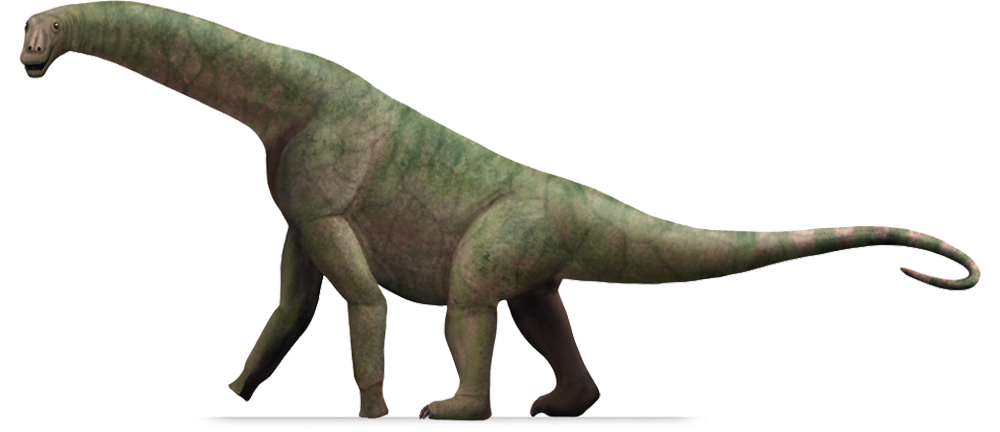
From some skull-less but otherwise decent remains and a lump of fungus-riddled fossilized poo that it may not even own, palaeontologists have deduced that this Indian sauropod was somewhere in the region of eighteen meters long, sixteen tons in weight, and ate a wide variety of leaves. However, its describers were less bold regarding its affinities, and when faced with the seemingly simple task of coining a new genus and claiming the glory that comes with it, they opted instead to raise the thirteenth species of a dinosaur that has since been trimmed to, well, one. And that one was hanging by a thread until its holotype, missing for 134 years, miraculously reappeared in 2012. Yes, we're talking about you, Titanosaurus.
Isisaurus was originally named Titanosaurus colberti by Jain and Bandyopadhyay in 1997 but was given its own name by Wilson and Upchurch in 2003 and assigned to Lithostrotia: a diverse family of titanosaurs containing the disappointingly medium-sized "giant lizards", some of which sport rather unique features. For example, Saltasaurus proved that some lithostrotians were armoured, with the name (meaning "paved with stones") chosen for that reason. Although, armour isn't a prerequisite for entry, which is fortunate because the only specimen of Isisaurus doesn't have any. But what it does have, according to some sources at least, is a stocky and vertically-directed neck with the shortest vertebrae of any titanosaur, angled by a short back and shoulders pushed high by forelimbs that were as long as the hindlimbs. We love a giraffe-like sauropod as much as the next man, but it's a tad presumptuous to pull such proportions from a specimen that includes only a fraction of the vertebral column and half of one front leg, and lacks back legs entirely.
Isisaurus was originally named Titanosaurus colberti by Jain and Bandyopadhyay in 1997 but was given its own name by Wilson and Upchurch in 2003 and assigned to Lithostrotia: a diverse family of titanosaurs containing the disappointingly medium-sized "giant lizards", some of which sport rather unique features. For example, Saltasaurus proved that some lithostrotians were armoured, with the name (meaning "paved with stones") chosen for that reason. Although, armour isn't a prerequisite for entry, which is fortunate because the only specimen of Isisaurus doesn't have any. But what it does have, according to some sources at least, is a stocky and vertically-directed neck with the shortest vertebrae of any titanosaur, angled by a short back and shoulders pushed high by forelimbs that were as long as the hindlimbs. We love a giraffe-like sauropod as much as the next man, but it's a tad presumptuous to pull such proportions from a specimen that includes only a fraction of the vertebral column and half of one front leg, and lacks back legs entirely.
Etymology
Isisaurus is derived from "Isi" (for the Indian Statistical Institute) and the Greek "sauros" (lizard). The species epithet, colberti, honours Edwin "Ned" Colbert.
Synonyms
Titanosaurus colberti (Jain and Bandyopadhyay, 1997)
Discovery
The remains of Isisaurus were discovered near Dongargaon Hill in the Lameta Formation, Chandrapur district, Maharashtra, central India, by a team led by Sohan L. Jain during three field seasons from 1984 and 1986. The holotype (ISI R335/1-65) is the partial skeleton of a single individual including vertebrae, shoulder and pelvic girdles, and bits of forelimb.
A braincase from the same quarry, and another from the Pab formation in Pakistan, might belong to Isisaurus.


