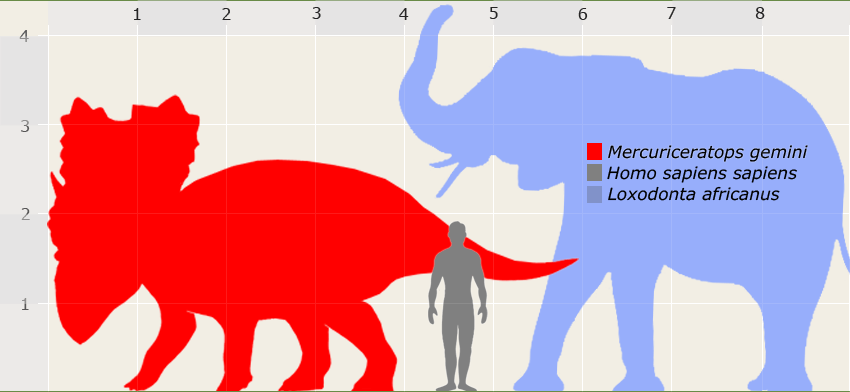
Pronunciation: mur-kyuh-ree-seh-ruh-tops
Meaning: Mercury horn face
Author/s: Ryan et al. (2014)
Synonyms: None known
First Discovery: Alberta, Canada
Acta Ordinal: #882
Mercuriceratops gemini
The Campanian-aged Mercuriceratops is based on two partial frills; one from the upper Judith River Formation of Montana and the other from the lower Dinosaur Park Formation of Dinosaur Provincial Park, Alberta, which makes it the first pre-Maastrichtian ceratopsid to have been found on both sides of the Canada/US border.
It's the oldest chasmosaurine from Canada, too, and bucked the recent trend of being based on remains that were previously named something else. However, it took the best part of a decade and a second specimen to convince palaeontologists that it deserved its own name.
Apart from protection against would-be predators, ceratopsians (the horn-faced dinosaurs including ceratopsids, and thus chasmosaurines and centrosaurines) used the highly ornamented bony frill on the back of their skull as a means of identification, and we're willing to bet that the bigger ones attracted the hottest mates as well as jealous glances from more modestly-endowed rivals. It's been that way since time began. The frill of each species was unique in shape and adorned with a combination of spikes, knobs and divets that was instantly recognizable to their own kind, and so it was for Mercuriceratops whose frill, sporting a design hitherto unseen in the fossil record, resembled a hornlet-edged butterfly.
Apart from protection against would-be predators, ceratopsians (the horn-faced dinosaurs including ceratopsids, and thus chasmosaurines and centrosaurines) used the highly ornamented bony frill on the back of their skull as a means of identification, and we're willing to bet that the bigger ones attracted the hottest mates as well as jealous glances from more modestly-endowed rivals. It's been that way since time began. The frill of each species was unique in shape and adorned with a combination of spikes, knobs and divets that was instantly recognizable to their own kind, and so it was for Mercuriceratops whose frill, sporting a design hitherto unseen in the fossil record, resembled a hornlet-edged butterfly.
(Twin Mercury horn face)Etymology
Mercuriceratops is derived from "Mercuri" (for the winged helmet of the godly Roman messenger Mercury) and the Greek "ceras" (horn) and "-ops" (face), referring to the "wing-like" protrusion on each side of its frill. Funnily enough, the official paper contains the text "close carriage return" in the etymology section, which could be interpreted as a link to the winged emblem of a certain delivery service, at a stretch. This shouldn't be there, it's just screwy formatting, probably an error caused by an unclosed tag within the document.
The species epithet, gemini, is named for Castor and Pollux (known collectively as the Dioskouri), the mythological sons of Leda, which refers to the "twin" specimens from Alberta and Montana. As the son of Zeus, born after the crafty Greek top god had seduced his mom in the form of a swan, Pollux was immortal. However, Castor, the son of the Spartan King Tyndareus, was not. When the latter died his pining brother offered to share his immortality, so Zeus turned them into the star constellation known as Gemini. ZooBank registry: urn:lsid:zoobank.org:act:5DC07F50-C8AC-4D01-A743-01B423CF110A.
Discovery
The type remains of Mercuriceratops were discovered in the upper Judith River Formation, Fergus County, Montana, by Kraig Derstler in 2007.
The holotype (ROM 64222) is a partial squamosal (the lower part of a frill).
A referred specimen (UALVP 54559, another partial squamosal) was discovered in the lower Dinosaur Park Formation, 1km east of "Happy Jack's Cabin" on the North side of the Red Deer River, Dinosaur Provincial Park, Alberta, Canada, by Susan Owen-Kagen on July 1, 2012.
Preparators
Ian Morrison (holotype).
Susan Owen-Kagen (referred specimen).