









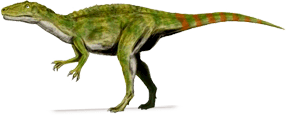
Pronunciation: foo-KOO-ee-RAP-tor
Meaning: Fukui plunderer
Author/s: Azuma and Currie (2000)
Synonyms: None known
First Discovery: Honshu, Japan
Acta Ordinal: #474
Fukuiraptor kitadaniensis
After its discovery at Fukui Prefecture on Honshu Island, Azuma and Currie heralded Fukuiraptor as the most complete theropod dinosaur ever discovered in Japan. But that isn't as boast-worthy as it sounds. At that point, Fukuiraptor was the only theropod dinosaur known from Japan, at least officially, and its remains, which are mostly leg bones plus the odd upper arm, jaw fragments and teeth, have caused more than their fair share of confusion.
A name-prompting curved "foot" claw typical of dromaeosaurids (or "raptors") actually belonged on its hand, and the first known specimen was thought to be a juvenile until fossils turned up that were only one-third the size of the original ones. Based on a bundle of thighbones of various lengths from the same quarry, the holotype appears to be the sub-adult stage of a single family group that lived there¹. But what it isn't, is the owner of the quarry's lonesome raptor tooth that David Lambert unofficially named "Kitadanisaurus"² in 1990 because, despite the name, Fukuiraptor isn't a raptor.
Like Lambert's equally unofficial "Katsuyamasaurus" which may be synonymous, Fukuiraptor is an allosauroid, specifically a megaraptoran neovenatorid allosauroid, but that's assuming, of course, that megaraptorans are neovenatorid allosauroids. In 2012, Novas and colleagues suggested that megaraptorans may be tyrannosauroids³ (a family of carnivorous critters from the other side of the theropod track), which would make Fukuiraptor a "Tyrant Lizard" and an archaic relative of Tyrannosaurus rex.
Note: The Japanese theropod ranks were bolstered by Fukuivenator paradoxus (Azuma et al.) in 2016.
A name-prompting curved "foot" claw typical of dromaeosaurids (or "raptors") actually belonged on its hand, and the first known specimen was thought to be a juvenile until fossils turned up that were only one-third the size of the original ones. Based on a bundle of thighbones of various lengths from the same quarry, the holotype appears to be the sub-adult stage of a single family group that lived there¹. But what it isn't, is the owner of the quarry's lonesome raptor tooth that David Lambert unofficially named "Kitadanisaurus"² in 1990 because, despite the name, Fukuiraptor isn't a raptor.
Like Lambert's equally unofficial "Katsuyamasaurus" which may be synonymous, Fukuiraptor is an allosauroid, specifically a megaraptoran neovenatorid allosauroid, but that's assuming, of course, that megaraptorans are neovenatorid allosauroids. In 2012, Novas and colleagues suggested that megaraptorans may be tyrannosauroids³ (a family of carnivorous critters from the other side of the theropod track), which would make Fukuiraptor a "Tyrant Lizard" and an archaic relative of Tyrannosaurus rex.
Note: The Japanese theropod ranks were bolstered by Fukuivenator paradoxus (Azuma et al.) in 2016.
[Fukui plunderer from Kitadani]Etymology
Fukuiraptor is derived from "Fukui" (prefecture) and the Latin "raptor" (plunderer, robber, snatcher or thief).
The species epithet, kitadaniensis, means "from Kitadani" in Latin (see discovery).
Discovery
The first fossils of Fukuiraptor were discovered at the Kitadani Dinosaur Quarry in the Kitadani Formation (Akaiwa Subgroup, Tetori Group), on the Sugiyama River in the northern part of Katsuyama City, Fukui Prefecture, Honshu Island, Japan, in 1988.The holotype (FPDM-V97122) is the partial skeleton of an immature individual including jaw fragments, teeth, vertebrae, and bones from the arms and hind limbs. The Kitadani Dinosaur Quarry is one of the largest dinosaur quarries in the world. As well as a plethora of fosssils that have been referred to Fukuiraptor, it has also yielded the iguanodontian Fukuisaurus tetoriensis, the hadrosauroid Koshisaurus katsuyama, the theropod Fukuivenator paradoxus and the sauropod Fukuititan nipponensis, plus fossilised plants, freshwater mollusks, fish, turtles, crocodiles and birds.


