









Pronunciation: al-BUHR-toh-NYE-kuss
Meaning: Alberta claw
Author/s: Longrich and Currie (2008)
Synonyms: None known
First Discovery: Alberta, Canada
Acta Ordinal: #669
Albertonykus borealis
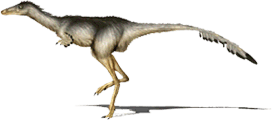
Albertonykus is one of only a few alvarezsaurids discovered outside of South America or Mongolia. At the time of its christening, it was also the smallest dinosaur of any stamp known from North America. The latter is no longer the case, but Albertonykus is still the smallest member of the North American branch of Alvarezsauridae, and its discovery proved that their weirdness was global.
Compared to their rather long hind limbs with a specialised "pinched" foot, the forelimbs of alvarezsaurids weren't long enough to scratch their own nose, but they were muscular and powerful. All of their digits had shrunk to almost nothing except for one: a huge thumb with a hooked claw, and they had long, slender jaws packed with tiny teeth.
Weighing up the sum of parts, it seems Albertonykus and its brethren were insect predators filling a niche taken in modern times by anteaters and pangolins, and likewise used their powerful forearms and claws to rip into the bark of trees and their long slender snouts to nibble wood-dwelling termites and other creepy-crawly goodies from within.
Compared to their rather long hind limbs with a specialised "pinched" foot, the forelimbs of alvarezsaurids weren't long enough to scratch their own nose, but they were muscular and powerful. All of their digits had shrunk to almost nothing except for one: a huge thumb with a hooked claw, and they had long, slender jaws packed with tiny teeth.
Weighing up the sum of parts, it seems Albertonykus and its brethren were insect predators filling a niche taken in modern times by anteaters and pangolins, and likewise used their powerful forearms and claws to rip into the bark of trees and their long slender snouts to nibble wood-dwelling termites and other creepy-crawly goodies from within.
(Northern Alberta Claw)
Etymology
Albertonykus is derived from "Alberta" (its area of discovery) and the Greek "onykh" (claw).
The species epithet, borealis, means "north", referring to its discovery on the North American continent.
Discovery
Albertonykus was discovered at "Dry Island Buffalo Jump" (aka Albertosaurus Quarry, Big Valley Creek) in the Horseshoe Canyon Formation (Edmonton Group) of Alberta, Canada, by a team led by Philip Currie in 2002. With an old photograph in hand, Currie used landmarks to painstakingly pinpoint the whereabouts of a mysterious bonebed packed with numerous specimens of Albertosaurus sarcophagus that Barnum Brown had mined for just two weeks way back in 1910. With the site re-discovered, further remains were recovered and carted back to Alberta's Royal Tyrell Museum. But no one realised Albertonykus fossils were among them until the University of Calgary's Nicholas Longrich arrived to compare the museum's collection of Albertosaurus claws to those of a poorly represented and as-yet-unnamed "ostrich" dinosaur he was studying. Longrich's fingernails must be the cleanest of all palaeontologists because he seems to do all of his "digging" in museum drawers. The Albertonykus holotype (TMP 2001.45.91) is an upper arm bone (left ulna).


