




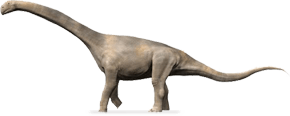
Pronunciation: TOO-ree-uh-SOR-us
Meaning: Turia lizard
Author/s: Royo-Torres et al. (2006)
Synonyms: None known
First Discovery: Aragón, Spain
Acta Ordinal: #621
Turiasaurus riodevensis
(Teruel lizard from Riodeva)Etymology
Turiasaurus is derived from "Turia" (the Latin name for the Teruel area of Spain) and the Greek "sauros" (lizard).
The species epithet, riodevensis, is derived from "Riodeva" (for Riodeva village where the
fossil site is located) and the Latin "ensis" (from).
ZooBank registry: urn:lsid:zoobank.org:act:AEABFE07-E4DD-4635-8B22-A6042B75E3DC.
Discovery
The remains of Turiasaurus were discovered in the Villar del Arzobispo Formation, at the Barrihonda-El Humero site in Riodeva village, Teruel, Aragón, Spain. The area has also yielded theropod teeth and remains of stegosaurs, ornithopods, fish, turtles
and crocodylomorphs.The holotype CPT-1195 to CPT-1210, housed in the Museo de la Fundación Conjunto Paleontológico de Teruel-Dinópolis, Teruel, Aragón, Spain) is an articulated left forelimb. Referred material (CPT-1211 to CPT-1261), found close to the holotype in an area 280 m2 and attributed to the same individual, consists of skull fragments, eight teeth, six neck vertebrae with ribs, three back vertebrae plus vertebral fragments and eight ribs, a partial sacrum, two tail vertebrae, a fragment of the left shoulder blade, part of a breast plate, a piece of left thighbone, shin and calf, part of a left ankle, two left toe bones, and a partial right foot. A complete tooth, a chevron, and an almost complete right forelimb and shoulder girdle (ML 368), discovered in the Lourinhã Formation at Vale Pombas, north of Lourinhã, Portugal, in 1996, was ascribed to Turiasaurus by Octavio Mateus in 2009. They were renamed Zby atlanticus by Mateus, Mannion and Upchurch in 2014.


