









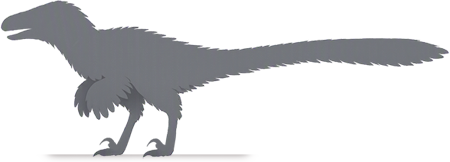
Pronunciation: PY-ro-RAP-tuh
Meaning: Fire thief
Author/s: Allain and Taquet (2000)
Synonyms: None known
First Discovery: Bouches-du-Rhône, France
Acta Ordinal: #484
Pyroraptor olympius
(Fire thief of Olympus)Etymology
Pyroraptor is derived from the Greek "pyros" (fire) and the Latin "raptor" (plunderer, snatcher, robber or thief), because this critter was discovered after a forest fire.
The species epithet, olympius, is named for Mount Olympus—not that Mount Olympus, which was the radiant home of the Greek Gods, but Mont Olympe (Mount Olympus) in Provence, at the foot of which Pyroraptor was discovered.
By the by, a Titan called Prometheus was also a fire-thief. He nicked it back from the Greek Mount Olympus, where it had been hidden by Zeus—who was furious that he had been tricked into accepting ox bones wrapped in fat as offerings to the gods—so humans couldn't cook their prime beef cuts. For punishment, the Titan found himself chained to a boulder with an eagle eternally pecking at his liver, while humanity had to deal with Pandora and her pesky box.
Discovery
The remains of Pyroraptor were discovered in the Grès à Reptiles Formation at La Boucharde, 2 kilometres to the south-east of Trets, Bouches-du-Rhône, France, by Mr and Mrs Michelon in 1992, mingled with remnants of Rhabdodon priscus, as yet-unnamed nodosaurid, titanosaurid, and ceratosaurian dinosaurs, dinosaurian eggshells, turtle-shell fragments, and bones from an alligator ancestor.
The holotype (MNHN B0001) is a complete ungual phalanx (the end bone of the toes that anchors the nail or claw) from the second toe of the left foot. A second bone from the second toe of the right foot (BO002), a left second metatarsal (BO003), a complete ungual phalanx from the second toe of the right foot (BO004), the right ulna (BO005) and teeth (BO014, BO015) make up the paratypes. Pyroraptor has also laid claim to various toe bones (MNHN BO006, BO007, BO008, BO009 and BO010), a finger bone (BO011), a hand bone (BO012), right radius bone from the lower arm (BO013), a tail vertebra (BO016), and a back vertebra (BO017) from the same area.


