






Pronunciation: bel-uh-SOR-us
Meaning: Fine lizard
Author/s: Dong (1990)
Synonyms: None known
First Discovery: Xinjiang, China
Acta Ordinal: #359
Bellusaurus sui
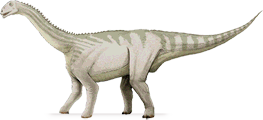
Bellusaurus is known from a mish-mash of bones, perhaps representing seventeen or more individuals, that were painstakingly excavated from Quarry 83003 in the Junggar Basin's "Dinosaur Valley" by Zhiming Dong in 1983.
Accusing fingers are often pointed at flash floods or some other form of naturally occurring disaster when such an accumulation of bones is discovered. But it's just as likely that these Bellusaurus — five meters long, light of build, and probably all juveniles — were faced with a wide river crossing during their yearly migration and were just too small and weak to make it to the other side.
Strangely enough for a relatively short-necked sauropod, some paleontologists class the spoon-toothed Bellusaurus as a member of Mamenchisaurinae: a group of Asian sauropods renowned for their insanely long necks. Others, however, suspect the adult version is actually Klamelisaurus gobiensis, another sauropod known from the same area.
Accusing fingers are often pointed at flash floods or some other form of naturally occurring disaster when such an accumulation of bones is discovered. But it's just as likely that these Bellusaurus — five meters long, light of build, and probably all juveniles — were faced with a wide river crossing during their yearly migration and were just too small and weak to make it to the other side.
Strangely enough for a relatively short-necked sauropod, some paleontologists class the spoon-toothed Bellusaurus as a member of Mamenchisaurinae: a group of Asian sauropods renowned for their insanely long necks. Others, however, suspect the adult version is actually Klamelisaurus gobiensis, another sauropod known from the same area.
(Sui's Beautiful lizard)Etymology
Bellusaurus is derived from the Latin "bellus" (fine or beautiful) - alluding to the excellent preservation of its fossils, and the Greek "sauros" (lizard).
The species epithet, sui, is named in honor of senior preparator Youling Sui. Bellusaurus was his last ever project.
Discovery
The remains of Bellusaurus were discovered at "Konglonggou" (IVPP Loc. 83003) in the Shishugou Formation (formerly the Wucaiwan), Qigu Group, northeastern Junggar Basin, Xinjiang, Sichuan Province, China, in 1983 by the Institute of Vertebrate Paleontology and Paleoanthropology, Academia Sinica, Xinjiang Paleontological Research Team. The holotype (IVPP V8299) consists of skull fragments and teeth. A referred specimen (V8300) is a composite skeleton with minimal skull elements and a portion of tail vertebrae.
Preparators
Youling Sui.


