









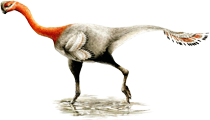
Pronunciation: ah-PAY-toh-RAP-tuhr
Meaning: Deceptive plunderer
Author/s: Funston and Currie (2016)
Synonyms: None Known
First Discovery: Alberta, Canada
Acta Ordinal: #941
Apatoraptor pennatus
In 1993, an articulated skeleton was collected from the Horseshoe Canyon badlands near Drumheller, Alberta, sealed in a plaster field jacket, then set aside for almost a decade, because the specimen within was thought to belong to a common-as-muck ornithomimid. Preparators finally opened the jacket in 2002, but when they realised no skull was present, they promptly closed it again and returned it to storage. When the jacket was reopened in 2008, the content's true identity began to emerge: beneath the rock were clues that this animal wasn't an "ostrich mimic" at all, but a rare member of the caenagnathid family, a group of theropod dinosaurs related to oviraptorosaurids.
The lower jaw—completely toothless, like a bird's—had a shape unlike any known species and was attached to a long neck composed of at least eleven air-filled vertebrae with fused neck ribs. Just as distinctive were the back ribs, each sporting a slender, finger-like projection not seen in its close relatives. The shoulders and arms were robust, the ulna (one of two forearm bones) carried a row of small quill knobs—attachment points for strong, wing-like feathers, and its hands combined a short first metacarpal with an unusually long first finger. Taken together, those features confirmed that the specimen represented an entirely new critter: Apatoraptor pennatus—the feathered deceptive plunderer, despite initial suggestions that it represented the coeval caenagnathid Epichirostenotes curriei.
The lower jaw—completely toothless, like a bird's—had a shape unlike any known species and was attached to a long neck composed of at least eleven air-filled vertebrae with fused neck ribs. Just as distinctive were the back ribs, each sporting a slender, finger-like projection not seen in its close relatives. The shoulders and arms were robust, the ulna (one of two forearm bones) carried a row of small quill knobs—attachment points for strong, wing-like feathers, and its hands combined a short first metacarpal with an unusually long first finger. Taken together, those features confirmed that the specimen represented an entirely new critter: Apatoraptor pennatus—the feathered deceptive plunderer, despite initial suggestions that it represented the coeval caenagnathid Epichirostenotes curriei.
(Feathered Deceptive Plunderer)Etymology
Apatoraptor is derived from the "apate" (the name of an evil spirit—the personification of deceit—released from Pandora's box in Greek mythology) and the Latin "raptor" (plunderer, snatcher, robber or thief), in reference to the specimen hiding its true identity for many years.
The species epithet, pennatus, means "feathered" in Latin, and refers to the quill knobs on its upper arm which would have anchored feathers.
ZooBank registry: urn:lsid:zoobank.org:act:0F59974D-EAC8-449B-8562-3331EAD55DF7.
Discovery
The remains of Apatoraptor were discovered in the Horsethief Member of the Horseshoe Canyon Formation near Drumheller, Alberta, Canada, in 1993.
The holotype (TMP 1993.051.0001) includes a lower jaw, a full series of neck and back and vertebrae, a right shoulder girdle and arm, a breastbone (sternum), "belly ribs" (gastralia), a partial hip bone (ilium), and a partial hind limb. This specimen represents the first known articulated skeleton of a caenagnathid.
Preparators
K. Aulenback and D. Tanke.


