




Pronunciation: EE-oh-RAP-tor
Meaning: Dawn plunderer
Author/s: Sereno et al. (1993)
Synonyms: None known
First Discovery: San Juan, Argentina
Acta Ordinal: #382
Eoraptor lunensis
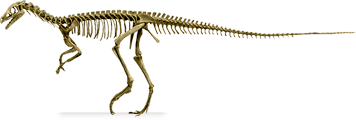
When Ricardo Martinez discovered Eoraptor in the Ischigualasto Badlands of Argentina in 1991, Paul Sereno hailed it as the earliest known theropod. And why wouldn't he? It was ancient, for starters, and its bipedal stance, hollow long bones, and a long tail for counterbalance seemed like a blueprint for future theropods. Add to that a proportion of sharp, recurved teeth, supple forearms, and grasping five-fingered hands bearing three functional clawed digits, along with the unclawed nubbins of a ring finger and pinky, and the case for a predatory lifestyle looked strong. But there were red flags. A number of leaf-shaped teeth better suited to herbivory than carnivory, slightly enlarged nostrils, and a lower jaw lacking the shock-absorbing intra-mandibular joint needed to withstand the forces of struggling prey, hinted at something else. These mixed signals simmered for years, until 2011, when Eoraptor’s place on the dinosaur family tree was challenged... by a specimen of itself.
The restudy of a skeleton discovered in 1996 and assigned to Eoraptor turned out to be an all-new critter that Martinez named Eodromaeus, "Dawn Runner". In one fell swoop, it took up squatter's rights in the "small primitive theropod closer to Tawa than to Herrerasaurus" niche, booting Eoraptor out of Theropoda and into Sauropodomorpha, possibly as a guaibasaurid: the small, bipedal sauropodomorphs that may have been omnivorous.
That's about as dramatic a leap as any dinosaur has ever made, and understandably, it's too much for some palaeontologists to fathom. Perhaps, given its mosaic of features, Eoraptor may be the earliest known "lizard-hipped" dinosaur — the ancestral saurischian straddling an evolutionary junction, with the road to Theropoda on one side and Sauropodomorpha on the other. However, ongoing research may once again redraw the map of early dinosaur evolution.
The restudy of a skeleton discovered in 1996 and assigned to Eoraptor turned out to be an all-new critter that Martinez named Eodromaeus, "Dawn Runner". In one fell swoop, it took up squatter's rights in the "small primitive theropod closer to Tawa than to Herrerasaurus" niche, booting Eoraptor out of Theropoda and into Sauropodomorpha, possibly as a guaibasaurid: the small, bipedal sauropodomorphs that may have been omnivorous.
That's about as dramatic a leap as any dinosaur has ever made, and understandably, it's too much for some palaeontologists to fathom. Perhaps, given its mosaic of features, Eoraptor may be the earliest known "lizard-hipped" dinosaur — the ancestral saurischian straddling an evolutionary junction, with the road to Theropoda on one side and Sauropodomorpha on the other. However, ongoing research may once again redraw the map of early dinosaur evolution.
(Dawn plunderer from the Valley of the Moon)Etymology
Eoraptor is derived from the Greek "Eo" (dawn), in reference to its primitive features and early temporal occurance, and the Latin "raptor" (plunderer), in reference to its grasping hands and presumed carnivorous lifestyle.
The species epithet, lunensis, is derived from the Latin "luna" (moon), for Valle de la Luna (Valley of the Moon), and "ensis" (from).
Discovery
The first fossils of Eoraptor were discovered close to the the same site as Herrerasaurus at "Valle de la Luna" in the Ischigualasto Formation, Ischigualasto Badlands, San Juan, northwestern Argentina (which was a river valley during the late Triassic) by University of San Juan palaeontologist Ricardo N. Martinez in 1991.
The holotype (PVSJ 512) is a partial skeleton.
Preparators
William F. Simpson and Bob Masek.


