CLAOSAURUS
a hadrosauroid dinosaur from the Late Cretaceous of North America.
Pronunciation: KLAY-a-SOR-us
Meaning: Broken lizard
Author/s: Marsh (
1890)
Synonyms: See
below
First Discovery: Kansas, USA
Acta Ordinal: #73
Claosaurus agilis
(Agile Broken Lizard)
Etymology
Claosaurus is derived from the Greek "klao" (broken) and "sauros" (lizard). The
species epithet,
agilis, means "agile" in Latin.
Hadrosaurus agilis (Marsh, 1872)
Thespesius agilis (Hay, 1902)
Trachodon agilis (Kuhn, 1936)
Discovery
The remains of
Claosaurus were discovered in the Smoky Hill Chalk Member of the Niobrara Chalk Formation, near Smoky Hill River, Logan County, western Kansas, USA, by O. C. Marsh in 1871. The
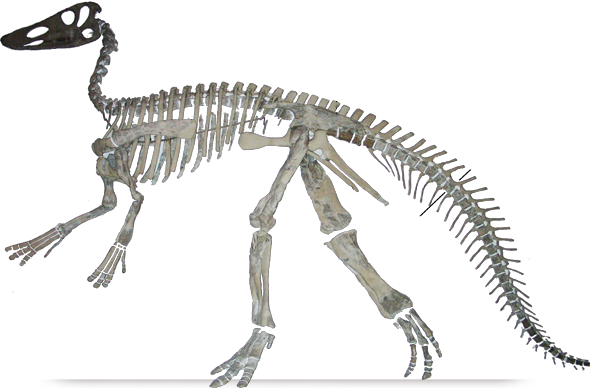
holotype (PM 1190) includes jaw fragments, a nearly complete
vertebral column, a right shoulder blade, both sternals, both
arms minus the hands, a right ilium (hip bone), both thighs, shin and calf fragments, and both feet.
Estimations
Timeline:
Era: Mesozoic
Epoch: Late Cretaceous
Stage: Santonian-Campanian
Age range: 87-82 mya
Stats:
Est. max. length: ?
Est. max. hip height: ?
Est. max. weight: ?
Diet: Herbivore
References
• The College Courant (March 30th, 1872) "
A New Species of Hadrosaurus".
The College Courant, 10(13): 149. [Hadrosaurus agilis.]
•
• Marsh OC (1872) Notice of a new species of "
Hadrosaurus".
American Journal of Science, 3(16): 301. [Hadrosaurus agilis.]
• Marsh OC (1890) "
Claosaurus agilis". In "
Additional characters of the Ceratopsidae, with notice of new Cretaceous dinosaurs".
The American Journal of Science, 3(39): 423.
• Cope ED (1889) "
Notes on the Dinosauria of the Laramie".
The American Naturalist, 23: 904-906.
• Cope ED (1892) "
Fourth note on the Dinosauria of the Laramie".
The American Naturalist v.26, second to last paragraph of page 758.
• Gregory JT (1948) "
The type of Claosaurus (?) affinis Wieland".
American Journal of Science, 246(1): 29-30.
• Carpenter K, Dilkes D and Weishampel DB (1995) "The Dinosaurs of the Niobrara Chalk Formation (Upper Cretaceous, Kansas)".
Journal of Vertebrate Paleontology, 15(2): 275–297. DOI: 10.1080/02724634.1995.10011230.
• Horner JR, Weishampel DB and Forster CA (2004) "Hadrosauridae". Page 438–463 in Weishampel, Dodson and Osmólska (eds.) "
The Dinosauria: Second Edition".
• Creisler BS (2007) "Deciphering duckbills: a history in nomenclature". Page 185–210 in Carpenter (ed.) "
Horns and Beaks: Ceratopsian and Ornithopod Dinosaurs".
• Paul GS (2010 "
The Princeton Field Guide to Dinosaurs".
• Prieto-Márquez A (2011) "Revised diagnoses of
Hadrosaurus foulkii Leidy, 1858 (the type genus and species of Hadrosauridae Cope, 1869) and
Claosaurus agilis Marsh, 1872 (Dinosauria: Ornithopoda) from the Late Cretaceous of North America".
Zootaxa, 2765(1): 61-68. DOI: 10.11646/zootaxa.2765.1.6.
• Prieto-Márquez A, Erickson GM and Ebersole JA (2016) "Anatomy and osteohistology of the basal hadrosaurid dinosaur
Eotrachodon from the uppermost Santonian (Cretaceous) of southern Appalachia".
PeerJ, 4: e1872. DOI: 10.7717/peerj.1872.
• Brownstein CD (2021) "Dinosaurs from the Santonian–Campanian Atlantic coastline substantiate phylogenetic signatures of vicariance in Cretaceous North America".
Royal Society Open Science, 8: 210127. DOI: 10.1098/rsos.210127.
Time stands still for no man, and research is ongoing. If you spot an error, or want to expand, edit or add a dinosaur, please use
this form. Go
here to contribute to our FAQ.
All dinos are GM free, and no herbivores were eaten during site construction!
To cite this page:
Atkinson, L.
"
CLAOSAURUS :: from DinoChecker's dinosaur archive".
‹
http://www.dinochecker.com/dinosaurs/CLAOSAURUS›. Web access: 14th Nov 2026.