





Pronunciation: Ta-WAH
Meaning: for the Pueblo Sun God
Author/s: Nesbitt et al. (2009)
Synonyms: None known
First Discovery: New Mexico, USA
Acta Ordinal: #679
Tawa hallae
It's not very often a critter is discovered that conveniently adds a few sentences to a missing chapter of dinosaur evolution, so, just like the little herbivores who were on the menu of this skinny, pint-sized predator, when palaeontologists spotted Tawa, their eyes almost popped out of their sockets. It was an all-new Triassic theropod. In North America!
Not to be confused with a flat cast-iron cooking griddle, an Indian river or the Kiwi soccer team, which all share the same name, Tawa (the Hopi name for the Pueblo sun god) was discovered in the same quarry as the enigmatic Triassic-aged Herrerasaurus and Coelophysis, and its pristine fossils sported features found in both. Funnily enough, the three belong to different theropod lineages and are not each other's closest relatives. Nor is Tawa a "missing link" or common ancestor, as Herrerasaurus and Coelophysis both have older relatives in the Ischigualasto Formation of Argentina. Argentina also boasts Triassic-aged sauropods and ornithischians while they're absent from anywhere in North America, which suggests that the ancestor of all dinosaurs rose on ancient Pangea (the whole world supercontinent, literally "entire Mother Earth") in the area that corresponds to modern South America, and its descendants began their march to global domination from there.
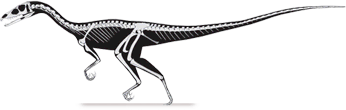
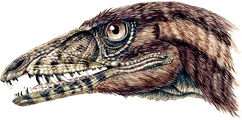 Like Coelophysis, Tawa had a "crocodile-like kink" in its snout and hollow bones, and its braincase and neck housed air sacks (much like modern birds), but its ilium (a hip bone) was Herrerasaurus-like. Original estimates of two meters in length and 3/4 meter hip height may be around 30% off, as the holotype wasn't fully grown, though it was very slight in build and so probably didn't weigh much more than 40kg as an adult. Tawa is currently loitering just outside of Neotheropoda on the dinosaurian family tree.
Coincidently, Tawa is also the name of a hybrid potato variety from the greenhouse of Iowa state college that is resistant to late blight and scab and immune to latent mosaic. Apparently, these spuds make cracking chips, but their mere mention in the same sentence as 'VIRUS-X' and their resistance to it is a little unsettling.
Not to be confused with a flat cast-iron cooking griddle, an Indian river or the Kiwi soccer team, which all share the same name, Tawa (the Hopi name for the Pueblo sun god) was discovered in the same quarry as the enigmatic Triassic-aged Herrerasaurus and Coelophysis, and its pristine fossils sported features found in both. Funnily enough, the three belong to different theropod lineages and are not each other's closest relatives. Nor is Tawa a "missing link" or common ancestor, as Herrerasaurus and Coelophysis both have older relatives in the Ischigualasto Formation of Argentina. Argentina also boasts Triassic-aged sauropods and ornithischians while they're absent from anywhere in North America, which suggests that the ancestor of all dinosaurs rose on ancient Pangea (the whole world supercontinent, literally "entire Mother Earth") in the area that corresponds to modern South America, and its descendants began their march to global domination from there.
Like Coelophysis, Tawa had a "crocodile-like kink" in its snout and hollow bones, and its braincase and neck housed air sacks (much like modern birds), but its ilium (a hip bone) was Herrerasaurus-like. Original estimates of two meters in length and 3/4 meter hip height may be around 30% off, as the holotype wasn't fully grown, though it was very slight in build and so probably didn't weigh much more than 40kg as an adult. Tawa is currently loitering just outside of Neotheropoda on the dinosaurian family tree.
Coincidently, Tawa is also the name of a hybrid potato variety from the greenhouse of Iowa state college that is resistant to late blight and scab and immune to latent mosaic. Apparently, these spuds make cracking chips, but their mere mention in the same sentence as 'VIRUS-X' and their resistance to it is a little unsettling.
Etymology
Tawa is named after "Tawa" (also spelled Taiowa and Taawa), the Hopi sun spirit and creator god.
The species epithet, hallae, honours Ruth Hall, founder of the Ghost Ranch Museum of Paleontology.
Discovery
The first Tawa fossils were stumbled upon by Hikers in the Petrified Forest Member of the Chinle Formation, Hayden Quarry, Ghost Ranch ("Rancho de los Brujos" meaning "Ranch of the Witches", to the locals), Rio Arriba
County, New Mexico, USA, in 2004.
The Holotype (GR 241) is a mostly complete, possibly sub-adult skull and skeleton. The nearly complete skeleton of a larger individual (GR 242) and at least six other individuals were found in the same area ("sITE 2") of the quarry.


