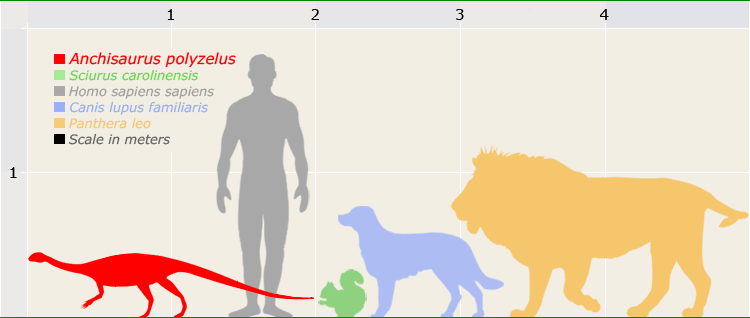
Pronunciation: ANG-kee-SOR-us
Meaning: Near lizard
Author/s: Marsh (1885)
Synonyms: See below
First Discovery: Massachusetts, USA
Acta Ordinal: #63
Anchisaurus polyzelus
(Much coveted near-lizard)Etymology
Anchisaurus is derived from the Greek "agkhi" (near) and "sauros" (lizard) to indicate its assumed role as an evolutionary stepping stone between ancestral archosaurs like Palaeosaurus and "proper" dinosaurs.
For what seemed like an eternity, the only evidence of former Connecticut Valley inhabitants were fossilised trackways, the first of which—found by Pliny Moody at his family's farm in South Hadley, Massachusetts in 1802—were initially identified as the footprints of Noah's Raven! So, when actual physical remains turned up in the form of fossils, O. C. Marsh chose the species epithet polyzelus, meaning "much coveted", because that's exactly what they were. ZooBank registry: urn:lsid:zoobank.org:act:ABE7B1F8-1846-42BF-A89B-6428D39D7FDA. Megadactylus polyzelus (Hitchcock, 1865) - preoccupied name
Amphisaurus polyzelus (Marsh, 1882) - preoccupied name
Yaleosaurus colurus (Huene, 1932)
Discovery
The first recorded dinosaur specimen from North America—a partial skeleton (YPM 2125) found during blasting for a well at Ketch's Mills in the Portland Formation (Agawam Group), East Windsor, Connecticut in 1818—were assigned to Anchisaurus by Richard Swann Lull in 1920. But it has since been discredited as non-diognostic. The Anchisaurus holotype (ACM 41109, housed at Amherst College's Pratt Museum of Natural History) was found by William Smith in the same formation at Springfield Armory, Hartford Basin, Hampden County, Massachusetts, during blasting to expand "Mill Pond" in 1855. Unfortunately, that specimen was discredited too. So, in 2015, the ICZN flexed its muscles in response to a 2012 petition from Peter Galton and installed a new holotype (a neotype): YPM 1883, an almost complete skull and skeleton from Walcott Quarry, Conneticut, that was initially the holotype of Anchisaurus colurus (Marsh, 1891), had been known as Yaleosaurus (von Huene, 1932) for decades, and which eventually became a synonym of Anchisaurus polyzelus.
Remains have been tentatively assigned to Anchisaurus from elswhere in North America, Nova Scotia and South Africa, but may, in fact, belong to Massospondylus.
Critter confusion!
Despite all being discovered within the same quarry (Wolcott's quarry, Manchester, Connecticut) in the late 1880s, O.C. Marsh managed to create quite a taxonomic tangle by assigning three more species to Anchisaurus.
Anchisaurus major (Marsh 1889). Based on YPM 208, Anchisaurus major was used to anchor an all new dinosaur named Ammosaurus major by Marsh in 1891.
Anchisaurus colurus (Marsh 1891). Based on YPM 1883, Anchisaurus colurus is the most complete specimen from Walcott's quarry and was renamed Yaleosaurus colurus by von Huene in 1932. It has has been accused of being the female form of Anchisaurus polyzelus, but was granted name-bearing rights when it became the "new" Anchisaurus holotype in 2015.
Anchisaurus solus (Marsh 1892). Based on YPM 209, Anchisaurus solus was assigned to Ammosaurus as Ammosaurus solus by von Huene in 1932.
All three of the above have been assigned to Anchisaurus polyzelus as synonyms. However, while most experts agree that these three specimens represent the same species, Paul Sereno reckons Anchisaurus itself is dubious at best and in no position to be accepting new specimens due to a lack of compareable parts. Therefore these diognostic remains from Manchester should all be assigned to the first named, non-Anchisaurus specimen: Ammosaurus major (Marsh 1891). But that is now impossible, seeing as the ICZN confirmed YPM 1883 (the Anchisaurus colurus specimen) as the new Anchisaurus polyzelus name-bearer in 2015.
More critter confusion!
Anchisaurus capensis.
In 1905, Robert Broom referred a partial skeleton (eleven back and six tail vertebrae, ribs, gastralia, part of a right shoulder blade, a partial pelvis and most of the right leg) discovered in South Africa to Hortalotarsus skirtopodus thinking that its modest size might be due to the specimen being a juvenile. When Von Huene referred Hortalotarsus skirtopodus to Thecodontosaurus (as Thecodontosaurus skirtopodus) in 1906, Broom reclaimed his critter because of the unique features of its hip and thigh and renamed it Gyposaurus capensis in 1911, but Galton and Cluver assigned it to Anchisaurus as Anchisaurus capensis in 1976. In 1981, Cooper regarded it as a probable juvenile Massospondylus carinatus.
By the by, local farmers were convinced that Hortalotarsus was a Bushman skeleton that would weaken the religious beliefs of the rising generation, so they smashed most of it to bits, according to Broom in 1911. However, Harry Seeley, who named Hortalotarsus in 1894, reckons the bones were lost due to a botched attempt to liberate them from their rocky tomb with gunpowder! Anchisaurus sinensis. Gyposaurus sinensis was named by Yang Zhongjian (C.C. Young) in 1940 for most of a skeleton with a partial skull found in the Lower Jurassic Lufeng Formation, Yunnan Province, China, and had over a dozen other specimens referred to it. In 1976, Galton assigned it to Lufengosaurus huenei as a juvenile version, but Dong Zhiming moved it to Anchisaurus as Anchisaurus sinensis in 1992. In the most recent review, Galton and Upchurch (2004) consider it a probably a valid, distinct taxon, in need of a new generic name.