









Pronunciation: rah-hoo-NAY-vis
Meaning: Menace-from-the-cloud bird
Author/s: Forster et al. (1998)
Synonyms: Rahona ostromi
First Discovery: Mahajanga, Madagascar
Acta Ordinal: #444
Rahonavis ostromi
Rahonavis was originally named "Rahona", but it lasted just 21 days before Forster, Sampson, Chiappe and Krause realised that name already belonged to a much smaller and far less interesting winged critter: a moth named by Griveaud way back in 1975. However, by cunningly prefixing "Rahona" ("menace" in Malagasy) with "avis" ("bird" in Latin), they managed to both circumnavigate the naming issue and perfectly portray its predatory lifestyle and assumed ability to fly.
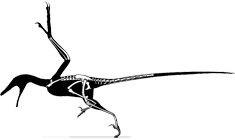
Despite being about the size of a crow and initially classified as an early branching species of our feathered friends close to Archaeopteryx (the "first bird"), Rahonavis isn't a bird. It has quill knobs on long lower arms for the attachment of feathers, six hip vertebrae fused into a bird-like synsacrum and supple shoulder joints with evidence of ligament attachments which afforded the mobility and strength needed for flapping flight, but those features don't make it a bird either. It could probably fly or at least spend some time off the ground in a self-propelled manner. But Rahonavis is an unenlagiine: one of a sub-group of theropod dinosaurs within Dromaeosauridae, which, along with troodontids, are considered the closest non-bird relatives of birds.
Typical of dromaeosaurids or "raptors", Rahonavis had a long tail and an enlarged claw on the second toe of each foot.
Despite being about the size of a crow and initially classified as an early branching species of our feathered friends close to Archaeopteryx (the "first bird"), Rahonavis isn't a bird. It has quill knobs on long lower arms for the attachment of feathers, six hip vertebrae fused into a bird-like synsacrum and supple shoulder joints with evidence of ligament attachments which afforded the mobility and strength needed for flapping flight, but those features don't make it a bird either. It could probably fly or at least spend some time off the ground in a self-propelled manner. But Rahonavis is an unenlagiine: one of a sub-group of theropod dinosaurs within Dromaeosauridae, which, along with troodontids, are considered the closest non-bird relatives of birds.
Typical of dromaeosaurids or "raptors", Rahonavis had a long tail and an enlarged claw on the second toe of each foot.
(Ostrom's menace-from-the-clouds bird)Etymology
The species epithet, ostromi, honors John Ostrom who breathed new life into Thomas Huxley's much maligned theory that birds evolved from dinosaurs.
Discovery
Rahonavis was discovered at the village of Berivotra in the Anembalemba Member of the Maevarano Formation, Mahajanga Province, northwestern Madagascar, by a joint expedition of SUNY (State University of New York) and the University of Antananarivo in 1995. Much of this area is covered in dense grass, but when fire exposed part of a hillside and revealed titanosaur fossils, Rahonavis was discovered amongst the remains.
The holotype (UA 8656) is a partial skeleton, including 7 back vertebrae, 6 fused hip vertebrae, and 13 tail vertebrae with chevrons, most of the hind limbs and pelvis, and a partial forelimb.
Referred material includes FMNH PR 2821 (complete right ulna), FMNH PA 746 (partial left upper arm bone), UA 9604 (partial right upper arm bone) and FMNH PA 740 (partial left lower jaw bone).


