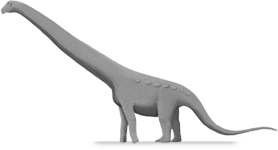
AEOLOSAURUS
a herbivorous titanosaurian sauropod dinosaur from the Late Cretaceous of Argentina.
Pronunciation: EE-o-lo-SOR-us
Meaning: Aeolus lizard
Author/s: Powell (
1987)
Synonyms: None known
First Discovery: Río Negro, Argentina
Acta Ordinal: #334
Aeolosaurus rionegrinus
(Wind lizard from Rio Negro)
Etymology
Aeolosaurus is derived from "Aeolus" (keeper of the Winds in Homer's Odyssey) and the Greek "sauros" (lizard), named for the frequent winds that blow across Patagonia.
The
species epithet,
rionegrinus, refers to its discovery in the Rio Negro Province.
Discovery
The first remains of
Aeolosaurus were discovered in the Angostura Colorada Formation at Casa de Piedra, Estancia Maquinchao, Río Negro Province, Argentina.
The
holotype (MJG-R 1) is a partial skeleton including seven tail vertebrae, both shoulder blades, both arms, right and left ischia, right lower leg, an ankle, five metacarpals, and some indeterminate fragments.
Estimations
Timeline:
Era: Mesozoic
Epoch: Late Cretaceous
Stage: Campanian-Maastrichtian
Age range: 73-67 mya
Stats:
Est. max. length: 15 meters
Est. max. hip height: ?
Est. max. weight: 14 tons
Diet: Herbivore
Other species
Aeolosaurus colhuehuapensis — Wind lizard from Lake Colhué Huapi — (Casal
et al., 2007), is based on UNPSJB-PV 959/1-959/27: tail vertebrae and chevrons from the upper member of the Bajo Barreal Formation, Chubut Province, Argentina.
Aeolosaurus maximus — Large wind lizard — (Santucci & De Arruba-Campos, 2011), is based on MPMA 12-0001-97: a partial skeleton from the Adamantina Formation (Bauru Group), approximately 12 Km SW of the city of Monte Alto, São Paulo State, Brazil. It was found in 1997 by Ademir Frare and his 12-year-old nephew Luiz Augusto dos Santos Frare, and excavated in 1997 and 1998 by staff of the Museu de Paleontologia de Monte Alto. After many years of suspicious glances, it was eventually renamed
Arrudatitan maximus by Julian Silva Junior
et al. in 2021.
References
• Powell JE (1987) "The Late Cretaceous fauna of Los Alamitos, Patagonia, Argentina part VI-the titanosaurids".
Revista del Museo Argentino de Ciencias Naturales “Bernardino Rivadavia”, 3: 147-153.
• Santucci RM and Bertini RJ (2001) "Distribuição paleogeográfica e biocronológica dos titanossauros (saurischia, sauropoda) do Grupo Bauru, Cretáceo superior do sudeste Brasileiro".
Revista Brasileira de Geociências, 31(3): 307–314.
• Gasparini Z, Coria RA and Salgado L (2007) "
"Patagonian Mesozoic Reptiles".
• Novas FE (2009) "
The Age of Dinosaurs in South America".
• Paul GS (2010) "
The Princeton Field Guide to Dinosaurs".
• Martinelli A, Riff D and Lopes R (2011) "Discussões sobre a presença do gênero
Aeolosaurus powell 1987 (dinosauria, titanosauria) no cretáceo superior do Brasil" [
Discussion about the occurrence of the genus Aeolosaurus Powell 1987 (Dinosauria, Titanosauria) in the Upper Cretaceous of Brazil].
Gaea: Journal of Geoscience, 7(1): 34-40. DOI: 10.4013/gaea.2011.71.03.
• Santucci RM and de Arruda-Campos AC (2011) "A new sauropod (Macronaria, Titanosauria) from the Adamantina Formation, Bauru Group, Upper Cretaceous of Brazil and the phylogenetic relationships
of Aeolosaurini".
Zootaxa, 3085(1): 1-35. DOI: 10.11646/zootaxa.3085.1.1.
• Molina-Pérez R and Larramendi A (2020) "
Encyclopedia of Dinosaurs: The Sauropods" [aka
Dinosaur Facts and Figures: The Sauropods and Other Sauropodomorphs].
• Silva JC Jr, Martinelli AG, Iori FV, Marinho TS, Hechenleitner EM and Langer MC (2021) "Reassessment of
Aeolosaurus maximus, a titanosaur dinosaur from the Late Cretaceous of Southeastern Brazil".
Historical Biology: An International Journal of Paleobiology, 34(3): 403-411. DOI: 10.1080/08912963.2021.1920016.
Time stands still for no man, and research is ongoing. If you spot an error, or want to expand, edit or add a dinosaur, please use
this form. Go
here to contribute to our FAQ.
All dinos are GM free, and no herbivores were eaten during site construction!
To cite this page:
Atkinson, L.
"
AEOLOSAURUS :: from DinoChecker's dinosaur archive".
‹
http://www.dinochecker.com/dinosaurs/AEOLOSAURUS›. Web access: 27th Oct 2026.