




Pronunciation: sheh-NAN-eye-SOR-us
Meaning: Chennane lizard
Author/s: Longrich et al. (2017)
Synonyms: None known
First Discovery: Khouribga, Morocco
Acta Ordinal: #963
Chenanisaurus barbaricus
Morocco isn't renowned for its dinosaur record. The theropod variety is particularly poorly represented, with abelisaurids among the rarest of those, though fragmentary remains have occasionally surfaced. A partial Cenomanian-aged upper jaw (UCPC 10) collected by locals in the Kem Kem beds, probably near Erfoud, and a partial thigh (OLPH 025) from Taouz near the Moroccan–Algerian border—gifted by a mystery donor in 2005 to the Museo Geologico e Paleontologico "Gaetano Giorgio Gemmellaro" in Palermo after being purchased from a Moroccan fossil dealer—have both been identified as abelisaurid. Yet neither specimen warranted a formal name, owing to their uncertain provenance, fragmentary nature, and poor preservation.
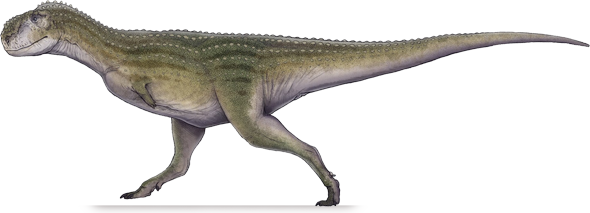
Against that sparse backdrop, Chenanisaurus barbaricus stands out. Although still depressingly fragmentary, it is by far the most complete abelisaurid known from latest Cretaceous Africa, and the first Moroccan abelisaurid to be given a formal name. It is also one of the largest abelisaurids known from anywhere, and one of the youngest dinosaurs yet discovered on the continent. Its remains come from the "Couche III" layers of Khouribga's phosphate beds, dated to the late Maastrichtian—just before non-avian dinosaurs met their match in the form of a six-mile-wide meteorite that stopped them dead in their tracks. Literally.
Chenanisaurus is a tad weird, both in terms of its large size and its unusually short, deep, and robust jaw, even by abelisaurid standards. Its place of discovery is unusual too. Morocco's phosphate beds represent an ancient seabed, packed with the remnants of teleost fishes, sharks, mosasaurs, plesiosaurs, turtles, and crocodilians. Even so, terrestrial dinosaurs and azhdarchid pterosaurs occur in the assemblage, indicating that the shoreline lay nearby and that carcasses occasionally washed out to sea.
Against that sparse backdrop, Chenanisaurus barbaricus stands out. Although still depressingly fragmentary, it is by far the most complete abelisaurid known from latest Cretaceous Africa, and the first Moroccan abelisaurid to be given a formal name. It is also one of the largest abelisaurids known from anywhere, and one of the youngest dinosaurs yet discovered on the continent. Its remains come from the "Couche III" layers of Khouribga's phosphate beds, dated to the late Maastrichtian—just before non-avian dinosaurs met their match in the form of a six-mile-wide meteorite that stopped them dead in their tracks. Literally.
Chenanisaurus is a tad weird, both in terms of its large size and its unusually short, deep, and robust jaw, even by abelisaurid standards. Its place of discovery is unusual too. Morocco's phosphate beds represent an ancient seabed, packed with the remnants of teleost fishes, sharks, mosasaurs, plesiosaurs, turtles, and crocodilians. Even so, terrestrial dinosaurs and azhdarchid pterosaurs occur in the assemblage, indicating that the shoreline lay nearby and that carcasses occasionally washed out to sea.
(Chennane lizard of Barbary)Etymology
Chenanisaurus is derived from "Chennane" (for the Sidi Chennane phosphate mines where it was found) and the Greek "sauros" (lizard). The species epithet, barbaricus, is derived from the Greek "barbaros" (savage), and also refers to Barbary (an old European term for the collective lands of the Berber People). Barbary roughly corresponds to modern day Morocco, Algeria, Tunisia, and Libya, and is known nowadays as Maghreb.
Discovery
The holotype of Chenanisaurus — a partial dentary (lower jaw bone) with four tooth roots and three crowns, catalogued as OCP DEK-GE 772 — was discovered in the Couche III phosphate beds at the Sidi Chennane mines of Khouribga, in the Ouled Abdoun Basin of Morocco, North Africa.
Referred specimens:Two isolated teeth (OCP DEK-GE 457 and DEK-GE 458) from the Couche III phosphate layer of Sidi Daoui in Morocco's Ouled Abdoun Basin.
An isolated upper jaw tooth with complete crown and partial root (WDC-CCPM-005) was obtained from a local dealer, and, as such, the details of its provenance are sketchy. It's likely from the Couche III of Sidi Chennane or Sidi Daoui, perhaps near the city of Oued Zem. It was described by Eric Buffetaut in 2005.
Preparator
Remmert Schouten.


