




Pronunciation: EE-oh-ti-RAN-us
Meaning: Dawn tyrant
Author/s: Hutt, et al. (2001)
Synonyms: None known
First Discovery: Isle of White, UK
Acta Ordinal: #504
Eotyrannus lengi
Along with Stokesosaurus and Aviatyrannis, Eotyrannus formed an archaic three-pronged fork that mercilessly poked holes in the theory that Tyrannosauroidea originated in Asia, by being the three oldest known members, and hailing from North America, Portugal and England, respectively. On top of that, they proved that tyrant lizards, which culminated in the hulking, tiny-armed, two-fingered powerhouse Tyrannosaurus rex right at the end of the age of dinosaurs, weren't always hulking, tiny-armed, two fingered powerhouses, but began as smaller, leggy and gracile critters with well-developed arms and long, slender, three fingered hands, and only began super-sizing once Mother Nature had cleansed their eco-systems of pesky allosauroids by the turn of the Early Cretaceous.
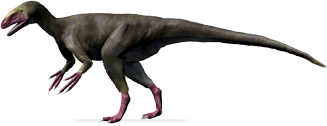
(Gavin Leng's Dawn Tyrant)Etymology
Eotyrannus is derived from the Greek "eos" (dawn) and "tyrannos" (tyrant) in reference to the critter's classification as an early tyrannosaur or "tyrant lizard".The species epithet, lengi (len-GEE), honors British amateur fossil collector Gavin Leng who discovered the specimen.
Synonyms
"Fusinasus" (Hunt, 2002, nomen nudum)"Gavinosaurus" (nomen nudum)
"Kittysaurus" (nomen nudum)
"Lengosaurus" (nomen nudum)
Discovery
The remains of Eotyrannus lengi were discovered in the Wessex Formation (Wealden Group) at Brighstone Bay on the Isle of Wight by Gavin Leng. The holotype (MIWG1997.550) is a mixed bag of skull and bones from a subadult specimen, around 4 meters long.


