




Pronunciation: mo-jo-SEH-ruh-tops
Meaning: Mojo horned face
Author/s: Longrich (2010)
Synonyms: None known
First Discovery: Alberta, Canada
Acta Ordinal: #749
Mojoceratops perifania
Cunningly avoiding the dirt and toil that go hand in hand with ground-fresh dinosaur discoveries, Nicholas Longrich "unearthed" the kickstarter that would lead to
Mojoceratops in New York's American Museum of Natural History amongst remains that were labelled as Chasmosaurus russelli. "It ain't Chasmosaurus", he thought. "Its frill is so right it's all wrong". And he was correct. The frill had been heavily reconstructed with plaster to look exactly like the Chasmosaurus frill on display beside it, right down to the finest detail. But the rest of it differed from your typical Chasmosaurus. A road trip to Canada with pitstops at the Royal Tyrrell Museum of Palaeontology and the NMC led to eight similar partial skulls. Then Longrich headed to the boozer to chug some ale before blurting out "Mojoceratops", and his colleagues-in-drinking nodded their approval. Groovy baby, yeah!
However, those not involved in the party can't quite get their head around why Longrich felt the need to brush aside two previous names based upon, by his own admission, almost identical comparable parts and instead raised a new name and referred Eoceratops canadensis and Chasmosaurus kaiseni to it, despite opining that neither can "be considered valid taxa". Some experts think that the correct name for this critter should be Eoceratops canadensis: a name that Lawrence Lambe coined way back in 1915 for a species he had previously assigned to Monoclonius. Others suspect Mojoceratops and everything it has laid claim to are either specimens of Chasmosaurus russelli or represent a different species of chasmosaurine entirely.
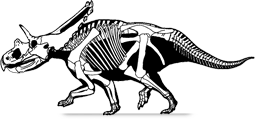
Mojoceratops, for now, is a ceratopsian: a neck-frilled, beak-mouthed, four-legged herbivore with huge upwards and outwards pointing brow horns. Despite being "only" around the size of a rather large rhino', its spectacular frill has more bells and whistles than almost all of its relatives, and to increase the mojo factor, it was heart-shaped. What self-respecting female with horns on her face could resist such an ostentatious display?
However, those not involved in the party can't quite get their head around why Longrich felt the need to brush aside two previous names based upon, by his own admission, almost identical comparable parts and instead raised a new name and referred Eoceratops canadensis and Chasmosaurus kaiseni to it, despite opining that neither can "be considered valid taxa". Some experts think that the correct name for this critter should be Eoceratops canadensis: a name that Lawrence Lambe coined way back in 1915 for a species he had previously assigned to Monoclonius. Others suspect Mojoceratops and everything it has laid claim to are either specimens of Chasmosaurus russelli or represent a different species of chasmosaurine entirely.
Mojoceratops, for now, is a ceratopsian: a neck-frilled, beak-mouthed, four-legged herbivore with huge upwards and outwards pointing brow horns. Despite being "only" around the size of a rather large rhino', its spectacular frill has more bells and whistles than almost all of its relatives, and to increase the mojo factor, it was heart-shaped. What self-respecting female with horns on her face could resist such an ostentatious display?
Etymology
Mojoceratops is a combination of "Mojo" and the Greek "ceras" (horn) and "ops" (face). "Mojo" is a hoodoo magic-charm pouch filled with toenail clippings, hair and other personal bits and bobs, often used for personal gain, particularly sexual gain. The theory is: the hugely ornamented frill of Mojoceratops gave the beast the "mojo" to attract members of the opposite sex.The species epithet, perifania, means "pride" in Greek.
Discovery
The remains of Mojoceratops were all discovered in the Dinosaur Park Formation of Western
Canada. The holotype (TMP 1983.25.1) is a partial skull, collected by amateurs prior to the passage of Alberta's Fossil Heritage Act and later acquired by the Royal Tyrrell
Museum of Paleontology. Unfortunately, due to the circumstances of the specimen's collection, no specific provenance data is available.
Referred material includes skull fragments (NMC 8803) from a bonebed along the South Saskatchewan River (now Lake
Diefenbaker) known as "Bearpaw Shale" and TMP 1999.55.292 from an unknown locality.
Provisionally referred specimens include a possibly subadult partial skull (AMNH 5656) found by Charles H. Sternberg
in the vicinity of Sand Creek, a partial skull (TMP 1979.11.147) from "Bonebed 43" that was
dominated by fossils of Centrosaurus apertus, a partial
skull (NMC 34893) found 1 mile
southeast of the ghost town of Steveville, and the holotype partial skulls of "Chasmosaurus kaiseni" (AMNH 5401) that that Barnum Brown named in 1933 and "Eoceratops canadensis" (NMC 1254) named by Lawrence Lambe in 1915. Either of the latter two specimens, if they are indeed diognostic, could have been considered as senior synonyms of what became instead Mojoceratops.


