









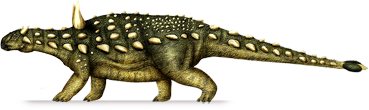
Pronunciation: a-LEE-to-PEL-tuh
Meaning: Wandering shield
Author/s: Ford and Kirkland (2001)
Synonyms: None known
First Discovery: California, USA
Acta Ordinal: #488
Aletopelta coombsi
Discovered in a ditch that was dug for a sewage pipe during the widening of College Boulevard near Carlsbad on the Californian coast in 1987, what would become Aletopelta was simply referred to as the "Carlsbad Ankylosaur" until Ford and Kirkland officially christened it in 2001. Apparently, its bloated carcass floated out to sea and formed a miniature reef environment after it sunk to the bottom, landing on its back judging by the bivalves that had attached themselves to its underside. Unfortunately, live sharks and their jaws had attached themselves repeatedly to the rest of it, leaving its limb bones with no knuckle ends and mostly hollowed out, and this poor state of preservation led Matthew Vickaryous to conclude, in 2004, that Aletopelta is a nomen dubium.
Coombs and Deméré illustrated and described these remains as best they could way back in 1996. But they didn't Christen them, because the naff fossils—representing the first ankylosaur, and one of the most complete dinosaur skeletons known from the Pacific coast of California—were also invaded and obscured by mudstone matrix, making a generic and specific identification at that point impossible.
Coombs and Deméré illustrated and described these remains as best they could way back in 1996. But they didn't Christen them, because the naff fossils—representing the first ankylosaur, and one of the most complete dinosaur skeletons known from the Pacific coast of California—were also invaded and obscured by mudstone matrix, making a generic and specific identification at that point impossible.
(Coombs' wandering shield)Etymology
Aletopelta is derived from the Greek "aletes" (wandering) and "pelte" (shield), because the tectonic plate on which its remains were found (containing the Peninsular Ranges Terrane, where Carlsbad and San Diego, California, are today) was originally somewhere opposite the middle of Mexico, and had thus wandered northward, carrying this dinosaur with it. The species epithet, coombsi (KOHM-zie) honors paleontologist and ankylosaur specialist Walter Preston Coombs, Jr.
Discovery
The remains of Aletosaurus were discovered at "Letterbox Canyon" in the Point Loma Formation (Rosario Group), near Carlsbad, California,
in 1987 by Bradford Riney.The holotype (SDNHM 33909) is a partial, poorly preserved skeleton lacking a skull.


