



Pronunciation: ZEE-no-puh-SYE-don
Meaning: Strange Poseidon
Author/s: Taylor and Naish (2007)
Synonyms: None known
First Discovery: Hastings, England
Acta Ordinal: #643
Xenoposeidon proneneukos
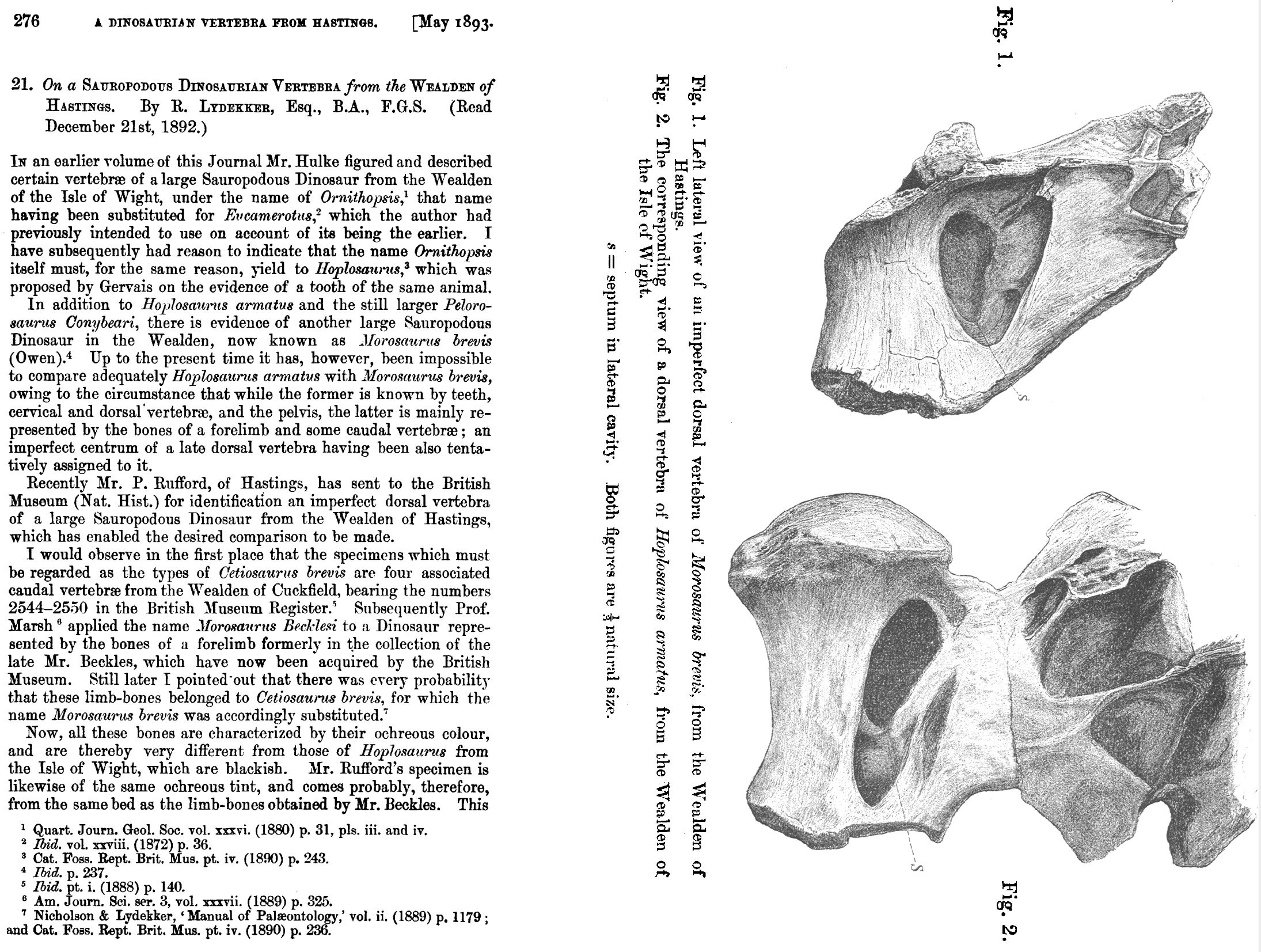
The single bone on which Xenoposeidon is based was briefly described in 1893 by Richard Lydekker who assumed it belonged to Morosaurus brevis, which is a name borne of error. Having watched Marsh move Pelorosaurus becklesii from Hastings to Wyoming's Morosaurus as Morosaurus becklesii in 1889 Lydekker was caught up in the trend, and although he thought Pelorosaurus becklesii was actually synonymous with Cetiosaurus brevis, and that a new vertebra from Hastings belonged to it, he moved the latter to Morosaurus anyway, erroneously using the new combination Morosaurus brevis. Morosaurus has since been sunk into Camarasurus but the vertebra was already laid to rest at London's Natural History Museum where it stayed, gathering dust, for the best part of 113 years.
It was stumbled upon, scrutinized, then wheeled out at the tail-end of 2007 by Mike Taylor and Darren Naish who found a plethora of unpronounceable and weirdly unique features aka autapomorphies ("the form of its neural arch, the posterior margin continuous with that of the cotyle, the accessory infraparapophyseal and postzygapophyseal laminae that meet in a 'V', and the asymmetric neural canal" ) which are lacking in all other species of sauropod from any time or place. Heck, beyond Neosauropoda, the authors struggled to find it a family, and it may represent an all new lineage of quadrupedal, plant-munching dinosaur, worthy of anchoring a family of its own. Or it might be a rebbachisaurid.
The funny thing about science is; there's always someone who disagrees with you. In fact, this is actively encouraged as it's what makes "good science". Having nurtured their baby for years, Taylor and Naish genuinely believe Xenoposeidon is very unique whilst others think it's very broken; smashed by a tag team of compressive force and Old Father Time. One of the doubters is Michael D'Emic who reckons the partial back vertebra from near its hip (id est, the entirety of its remains), all shiny and copper-coloured, would make a lovely paperweight but beyond that it's pretty useless.
It was stumbled upon, scrutinized, then wheeled out at the tail-end of 2007 by Mike Taylor and Darren Naish who found a plethora of unpronounceable and weirdly unique features aka autapomorphies ("the form of its neural arch, the posterior margin continuous with that of the cotyle, the accessory infraparapophyseal and postzygapophyseal laminae that meet in a 'V', and the asymmetric neural canal"
) which are lacking in all other species of sauropod from any time or place. Heck, beyond Neosauropoda, the authors struggled to find it a family, and it may represent an all new lineage of quadrupedal, plant-munching dinosaur, worthy of anchoring a family of its own. Or it might be a rebbachisaurid.
The funny thing about science is; there's always someone who disagrees with you. In fact, this is actively encouraged as it's what makes "good science". Having nurtured their baby for years, Taylor and Naish genuinely believe Xenoposeidon is very unique whilst others think it's very broken; smashed by a tag team of compressive force and Old Father Time. One of the doubters is Michael D'Emic who reckons the partial back vertebra from near its hip (id est, the entirety of its remains), all shiny and copper-coloured, would make a lovely paperweight but beyond that it's pretty useless.
Etymology
Xenoposeidon is derived from the Greek "xenos" (strange or alien) and "Poseidon" (Greek god of the sea). "Poseidon" is a suffix that the authors have adopted for "earth-shaking" sauropods just as "raptor" is applied to small vicious theropods, though it should really be "Enosichthon" [earth shaker], which is Poseidon's guise as the god of earthquakes.
The species epithet (or specific name), proneneukos (pro-nen-YOO-koss), is derived from the Latin "pronus" (forward sloping), because the upper part of its vertebra (the neural arch) slopes forwards.
ZooBank registry: urn:lsid:zoobank.org:act:1801F6BB-B8D5-44E1-9F18-AB024AA05F3A.
Discovery
The remains of Xenoposeidon may have been discovered in the Ashdown Beds Formation (Hastings Beds Group) at Ecclesbourne Glen, about 2 km east of Hastings, East Sussex, England, by fossil hunter Phillip James Rufford in the early 1890s. Precise location info (if it was even logged in the first place) has been lost, but this is where Rufford collected most of his fossils. At least the ones he bothered to document.
The holotype (BMNH R2095, housed at the Natural History Museum, London) is a partial vertebra from near the hip.