









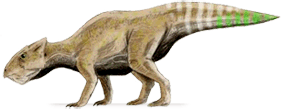
Pronunciation: YAH-mah-SEH-ruh-tops
Meaning: Yama horned face
Author/s: Makovicky and Norell (2006)
Synonyms: None known
First Discovery: Gobi desert, Mongolia
Acta Ordinal: #610
Yamaceratops dorngobiensis
(Death God Horn-face from the Eastern Gobi)Etymology
Yamaceratops is derived from "Yama" (the Hindu/Buddhist God of Death), and the Greek "ceras" (horn) and "ops" (face). The name refers to both Yama and the family Ceratopsia to which Yamaceratops belongs having horned faces, but, funnily enough, Yamacetatops doesn't. Yama began in Vedic mythology, where he was the first mortal to die and therefore became their death deity by default, but he's not all bad. He is the God of justice, balance and natural law, the alokapala (Guardian of the Directions) who looks after the south, and the judge of souls in charge of the wheel of rebirth. Such an all-rounder was always going to be in demand and Yama was quickly adopted by Buddhism and became popular in China, Korea, Japan and Tibet. He was also inducted into the Hindu pantheon, though as a subortinate to the triad of top gods—Vishnu, Shiva and Brahma, who were super-charged by holy scribblers to halt the march of Buddhism as the religion of choice.
The species epithet, dorngobiensis, is derived from "dorngobi" (aka Dornogovi Aimag: "eastern Gobi Province") and the Latin "ensis" (from).
Discovery
The first remains of Yamaceratops were recovered from the Shine
Us Khudag redbeds (previously referred to as "Khugenetslavkant sandstone facies") in the Javkhlant Formationat Dorngobi Aimag (eastern Gobi Desert),
Mongolia, by a joint American Museum of Natural History and Mongolian Academy of Sciences expedition in 1991.The holotype (IGM 100/1315) is a partial skull. Other bits and bobs discovered in 2002 and 2003, and a fossilized embryo found within an ornithischian eggshell in the same area, may belong to Yamaceratops.


