Pronunciation: rin-CHEH-nee-uh
Meaning: for Rinchen Barsbold
Author/s: Osmólska (2004)
Synonyms: Oviraptor mongoliensis
First Discovery: Ömnögovi, Mongolia
Acta Ordinal: #551
Rinchenia mongoliensis
Seldom do palaeontologists name dinosaurs after themselves. Not because they aren't allowed to; it's just, you know, considered bad etiquette. But that didn't faze Barsbold Rinchen—kinda—nor Malkani, who’s done the same thing since—when he realised that his new species of Oviraptor wasn't an Oviraptor at all.
Formerly known as Oviraptor mongoliensis, Barsbold reassessed this specimen in 1997 and affectionately referred to it as Rinchenia, a nickname of sorts, based on his patronym—a personal name that honours the given name of one's father, in this case Byambyn Rinchen—until he found the time to describe its unique features. He never did, so it remained a "nomen nudum" (a naked name). But it became official when a published description by Halszka Osmólska arrived in 2004.
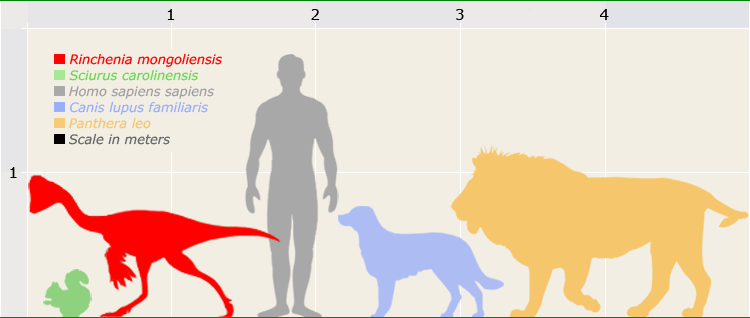
Known from a single specimen, Rinchenia mongoliensis was similar in size to Oviraptor but less robust, and sported a domed crest that was very distinct because of the many "scalp" bones that were built into its form: it was literally an extension of the skull. The original skull of Oviraptor, however, is so mangled that it's hard to tell if it even had a head crest. It was given one, though, in almost all early reconstructions and illustrations, due to the presence of a crest on another wrongly-assigned Oviraptor specimen that later became Citipati osmolskae.
Formerly known as Oviraptor mongoliensis, Barsbold reassessed this specimen in 1997 and affectionately referred to it as Rinchenia, a nickname of sorts, based on his patronym—a personal name that honours the given name of one's father, in this case Byambyn Rinchen—until he found the time to describe its unique features. He never did, so it remained a "nomen nudum" (a naked name). But it became official when a published description by Halszka Osmólska arrived in 2004.
Known from a single specimen, Rinchenia mongoliensis was similar in size to Oviraptor but less robust, and sported a domed crest that was very distinct because of the many "scalp" bones that were built into its form: it was literally an extension of the skull. The original skull of Oviraptor, however, is so mangled that it's hard to tell if it even had a head crest. It was given one, though, in almost all early reconstructions and illustrations, due to the presence of a crest on another wrongly-assigned Oviraptor specimen that later became Citipati osmolskae.
Etymology
Rinchenia was named in honour Byambyn Rinchen in 1997. The name became official when Halszka Osmólska and colleagues fully described its fossils in 2004.
The species epithet, mongoliensis, means "from Mongolia" in Latin.
Discovery
The remains of Rinchenia were discovered in the Nemegt Formation, Ömnögovi, Mongolia, in 1984. The Holotype (GI 100/32A) consists of a complete skull, plus some vertebra, partial hind and forelimbs, and a wishbone, which pretty much amounts to the left-overs from a thanksgiving roast turkey.