









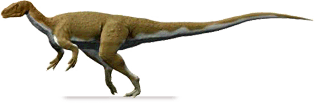
Pronunciation: cam-a-REE-yuh-SOR-us
Meaning: Camarilla lizard
Author/s: Sánchez-Hernández and Benton (2012)
Synonyms: None known
First Discovery: Teruel, Spain
Acta Ordinal: #831
Camarillasaurus cirugedae
Camarillasaurus is a trail-blazer. Not only is it the first vertebrate reported from Spain's Camarillas locality and one of only two ceratosaurs (behind the abelisauroid Genusaurus) known from the whole of Europe, but it's also the first and only European non-abelisauroid ceratosaurian to hail from the Early Cretaceous.
As such, it has done its bit to plug the so-called "ceratosaur gap"; a 20-million year void between ceratosaurs of the Late Jurassic and those of the Mid-Late Cretaceous which was previously "filled" by the fragmentary remains of Ligabueino, possibly Spinostropheus, several dubious critters, and remains which are so poor that no-one has even bothered to name them.
Etymology
Camarillasaurus is derived from "Camarillas" (the village and Formation where its remains were found), and the Greek "sauros" (lizard).
The species epithet, cirugedae, honors Pedro Cirugeda Buj. ZooBank registry: urn:lsid:zoobank.org:act:472B7908-0DE1-4DE3-944D-A4F38A287D87.
Discovery
The remains of Camarillasaurus were discovered in the Camarillas Formation at Fuente Arnar, near Camarillas village (Galve Subbasin, Aliaga Basin, Iberian Range), Teruel Province, Aragón, NE Spain, by Pedro Cirugeda Buj whilst ploughing the family field.
The holotype (MPG-KPC1-46) is a partial tooth, associated isolated vertebrae, ribs, and limb elements, that were mingled with the remains of a second, smaller theropod and some fossilised poo.


