









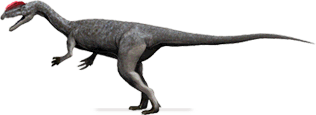
Pronunciation: die-LOAF-o-SOR-us
Meaning: Two-ridged lizard
Author/s: Welles (1970)
Synonyms: See below
First Discovery: Arizona, USA
Acta Ordinal: #203
Dilophosaurus wetherilli
After their excavation in 1942 by Bill Rush, Ed Cott, and the late Sam Welles, the fossils that would eventually become Dilophosaurus were carted back to Berkeley for cleaning and mounting and given the name Megalosaurus wetherilli in 1954. A decade later, Welles made another discovery not far from the holotype quarry and, in 1970, coined Dilophosaurus for the twin skull crests that were clearly visible on the new specimen. As it turns out, the crests were actually present on the original skull. But they were crushed and smushed together and misidentified as a displaced cheekbone.
The two-ridged lizard is one of the earliest known Jurassic theropods, but it's also among the least understood. What we do know, however, is that it's the largest land-dwelling animal known to have lived in North America during the Early Jurassic so was a lump bigger than the ones portrayed in Jurassic park, and it didn't have a frilly neckpiece. Nor is there any evidence to suggest it could spit venom like its movie namesake, though one particular feature it did have has also prompted considerable debate.
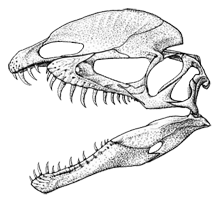 Dilophosaurus has a kink in its snout just behind its front row of teeth, which led to an early hypothesis that its jaws were too weak to tackle live prey. The theory is that the kink caused a fault in the jaw that struggling prey could snap, but a similar design quirk doesn't seem to hamper modern-day crocodiles.
Many theropod dinosaurs sport bone injuries that tell tales of calamities and catastrophes, but Dilophosaurus trumps them all. The left side of the holotype has a fractured scapula and one of two forearm bones (ulna), while the other (radius), plus the thumb, has large fibriscesses (fibrous abscesses). The right side fairs no better, with three bony tumours on the radius, an abnormally twisted upper arm (humerus), and deformities in the knuckle end of metacarpal III and the adjoining finger. Remarkably, the individual might have lived to a ripe old age because the ailments (apart from the humerus and third finger, which were permanently deformed, possibly due to the first reported case of dinosaurian osteodysplasia) had fully healed. But while they did, its arms would've been virtually useless for hunting, and its supposedly "weak" jaws became solely responsible for dispatching prey.
The two-ridged lizard is one of the earliest known Jurassic theropods, but it's also among the least understood. What we do know, however, is that it's the largest land-dwelling animal known to have lived in North America during the Early Jurassic so was a lump bigger than the ones portrayed in Jurassic park, and it didn't have a frilly neckpiece. Nor is there any evidence to suggest it could spit venom like its movie namesake, though one particular feature it did have has also prompted considerable debate.
Dilophosaurus has a kink in its snout just behind its front row of teeth, which led to an early hypothesis that its jaws were too weak to tackle live prey. The theory is that the kink caused a fault in the jaw that struggling prey could snap, but a similar design quirk doesn't seem to hamper modern-day crocodiles.
Many theropod dinosaurs sport bone injuries that tell tales of calamities and catastrophes, but Dilophosaurus trumps them all. The left side of the holotype has a fractured scapula and one of two forearm bones (ulna), while the other (radius), plus the thumb, has large fibriscesses (fibrous abscesses). The right side fairs no better, with three bony tumours on the radius, an abnormally twisted upper arm (humerus), and deformities in the knuckle end of metacarpal III and the adjoining finger. Remarkably, the individual might have lived to a ripe old age because the ailments (apart from the humerus and third finger, which were permanently deformed, possibly due to the first reported case of dinosaurian osteodysplasia) had fully healed. But while they did, its arms would've been virtually useless for hunting, and its supposedly "weak" jaws became solely responsible for dispatching prey.
(John Wetherill's two-crested lizard)Etymology
Dilophosaurus is derived from the Greek "di" (two), "lophos" (crest) and "sauros" (lizard), for a pair of curved parallel crests running the length of its skull. The species epithet (or specific name), wetherilli, honours Kansas-born explorer John Wetherill.
Discovery
The first fossils of Dilophosaurus were discovered by Navajo local Jessie Williams in 1940 in the Kayenta Formation on Navajo land, 200 yards northeast of a fence on the road to Moenave near Tuba City, Coconino County, Arizona, and collected by Sam Welles, William H. Rush and H.E. Cott in 1942.
The holotype and paratype (UCMP 37302 and UCMP 37303) consist of a nearly complete juvenile skeleton and a partial juvenile skull and skeletal elements that are missing from the holotype.
Welles found a large, name-prompting, specimen (UCMP 77270) about a quarter mile south of the holotype site in 1964.
During the summer of 1997, teams from the University of Texas and Navajo Nation EcoScouts found two more individuals (TMM 47006-1 and TMM 43646-1) at Arizona's "Gold Spring", 30 miles southeast of the type quarry, one of which (TMM 43646-1) is from the same quarry as the hypodigm of Sarahsaurus.
A few bits and bobs of what was initially thought to be a new species were also found in China, but the remains of "Dilophosaurus" sinensis turned out to belong to Sinosaurus. Megalosaurus wetherilli (Welles, 1954) Dilophosaurus breedorum (Welles and Pickering, 1999)
In 1984, based on differences in the skull, vertebrae, and thighs, Welles suggested that specimen UCMP 77270 did not belong to Dilophosaurus, although he did maintain that they both bore crests. Welles died in 1997, before he could officially name this supposed new dinosaur, and all was quiet on the idea that the two were separate genera, until 1999, when amateur paleontologist Stephan Pickering privately published the new name Dilophosaurus "breedorum" — in honour of William J. Breed, the Museum of Northern Arizona's curator of geology, who had assisted in collecting it — for UCMP 77270. Self-publishing gets right on palaeontlogist's nerves, so this new name was always likely to be dismissed out of hand. However, UCMP 77270 has been scrutinized on several occasions, but any differences weren't seemed significant enough to seperate it from other Dilophosaurus wetherilli specimens.
Trackways
Tracks in Arizona's Kayenta Formation that were named Kayentapus hopii and Dilophosauripus williamsi by Sam Welles in 1971, including five three-toed footprints (UCMP 83668) at Moenkopi Wash, may have been made by Dilophosaurus.


