




Pronunciation: sor-OR-nee-THOY-deez
Meaning: Bird-like lizard
Author/s: Osborn (1924)
Synonyms: Troodon mongoliensis (Paul, 1988)
First Discovery: Ömnögovi, Mongolia
Acta Ordinal: #148
Saurornithoides mongoliensis
Not to be confused with Sinornithoides — a close relative who, like Mei long, was discovered in a snoozing position with its snout tucked under its left "wing" — Saurornithoides was the first troodontid deinonychosaur ever found in Asia.
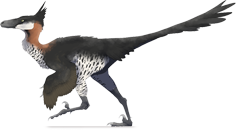
The presence of large eye sockets suggests they were nocturnal hunters, with a leggy, lightweight build, ideally suited to tearing around the now Gobi Desert in the still of night. Like the American Troodon, a relatively large brain put Saurornithoides in the smart class of dinosaurs. But dining etiquette was still lacking, and scientists have long speculated that they, and deinonychosaurs in general, used their long arms and grasping hands to seize live prey, and their feet, equipped with large-clawed second toes, to slash the poor thing to death.
Saurornithoides means "bird-like lizard" because of its presumed proximity to the ancestry of birds. But its name was almost lost when a clumsy publisher attached a footnote of Nopsca's renaming of fossils previously assigned to Iguanodon prestwichii (intended for Teinurosaurus) to Saurornithoides in a genus list in 1928.
Recently, the notion that troodontid and dromaeosaur "killing claws" were primarily used as claws for killing has been called into question. Most experts now believe these dinosaurian predators used their claws to "pin" struggling prey as they flapped their wings for balance, much like modern eagles and hawks, while they ate it to death.
The presence of large eye sockets suggests they were nocturnal hunters, with a leggy, lightweight build, ideally suited to tearing around the now Gobi Desert in the still of night. Like the American Troodon, a relatively large brain put Saurornithoides in the smart class of dinosaurs. But dining etiquette was still lacking, and scientists have long speculated that they, and deinonychosaurs in general, used their long arms and grasping hands to seize live prey, and their feet, equipped with large-clawed second toes, to slash the poor thing to death.
Saurornithoides means "bird-like lizard" because of its presumed proximity to the ancestry of birds. But its name was almost lost when a clumsy publisher attached a footnote of Nopsca's renaming of fossils previously assigned to Iguanodon prestwichii (intended for Teinurosaurus) to Saurornithoides in a genus list in 1928.
Recently, the notion that troodontid and dromaeosaur "killing claws" were primarily used as claws for killing has been called into question. Most experts now believe these dinosaurian predators used their claws to "pin" struggling prey as they flapped their wings for balance, much like modern eagles and hawks, while they ate it to death.
(Mongolian bird-like lizard)
Etymology
Saurornithoides is derived from the Greek "ornithos" (bird), "oid" (likeness, form) and "sauros" (lizard).The species epithet, mongoliensis, means "from Mongolia" in Latin. Initially, Henry Fairfield Osborn intended to use the name "Ornithoides" (bird-like) and mentioned it, without a description, in a popular publication in 1924, but changed his mind for the official description later the same year. ZooBank registry: urn:lsid:zoobank.org:act:046BF726-0EDE-4A3A-BE9E-4104C274E203.
Discovery
The first remains of Saurornithoides were discovered in the Djadochta Formation at the "Flaming Cliffs" (aka Bayn Dzak and Shabarakh Usu), Ömnögovi, Mongolia, by "Chinese assistant Chih" on July 9th, 1923, during the American Museum of Natural History's Central Asiatic expeditions.
The holotype (AMNH 6516) includes a partial skull, backbone, pelvis, legs, and feet. Specimen IVPP V 10597 (a partial left hindlimb) was originally thought to be the property of a juvenile Saurornithoides mongoliensis, but in 2012 Matt Carrano realised it was actually quite unique. It was revisited, reviewed and reassigned by Xing Xu and colleagues later the same year, and is now known as Philovenator curriei.
Sinornithoides junior
Discovered in 1964 and named by Rinchen Barsbold a decade later, Sinornithoides junior (younger bird-like lizard) was the first dinosaurian specimen ever collected by a professional Mongolian palaeontologist. Based on IGM 100/1, which is larger than Saurornithoides mongoliensis and from slightly younger rocks in Ulan Bator, Sinornithoides junior was re-classified as an all-new dinosaur — Zanabazar — by Mark Norrell and colleagues in 2009.


