









Pronunciation: aw-kuh-SOR-us
Meaning: Auca lizard
Author/s: Coria, Chiappe and Dingus (2002)
Synonyms: None known
First Discovery: Neuquén, Argentina
Acta Ordinal: #513
Aucasaurus garridoi
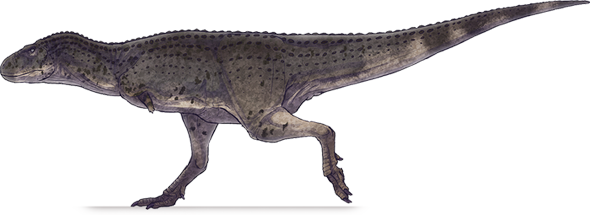
Alberto Garrido found Aucasaurus in what appears to be an ancient lake bed in 2002, and it was heralded later the same year as the closest relative of another South American abelisaurid: the impressively-horned Carnotaurus. The pair share many features, though the former is only three-quarter size compared to the latter and has even shorter arms. Its hands were weirder too, with four metacarpals but no fingers on what would be digits one and four, while digits two and three had fingers but no claws. Like all abelisaurids, a short and high skull gave the impression that it had been chasing a swinging anvil, but the face of Aucasaurus was more squished than most because, well, it really was squished.
Despite its mangled state, it's clear that the skull of Aucasaurus lacks a couple of Carnotaurus-typical features, like horns, for example. And some palaeontologists wonder just how Coria and colleagues managed to completely avoid comparing it to another hornless abelisaurid from the same area when they described its remains in 2002. Their consistency was no mean feat, bearing in mind they were ignoring the anchor of Abelisauria; the family to which all abelisaurids belong. But the two will be compared by someone eventually, and we won't be at all surprised if Aucasaurus turns out to be Abelisaurus, the shamefully overlooked abelisaurid of which we speak.
Missing only the end half of its tail, Aucasaurus is the most complete abelisaurid discovered thus far, and its damaged noggin has been the subject of much speculation. Perhaps this young up-start was the first loser in a lakeside melée over food, then drifted off into the lake and was buried in mud before Old Father Time and his elements could dish out a second beating. The much larger carnivorous theropod Aerosteon also inhabited this area. Just saying.
Despite its mangled state, it's clear that the skull of Aucasaurus lacks a couple of Carnotaurus-typical features, like horns, for example. And some palaeontologists wonder just how Coria and colleagues managed to completely avoid comparing it to another hornless abelisaurid from the same area when they described its remains in 2002. Their consistency was no mean feat, bearing in mind they were ignoring the anchor of Abelisauria; the family to which all abelisaurids belong. But the two will be compared by someone eventually, and we won't be at all surprised if Aucasaurus turns out to be Abelisaurus, the shamefully overlooked abelisaurid of which we speak.
Missing only the end half of its tail, Aucasaurus is the most complete abelisaurid discovered thus far, and its damaged noggin has been the subject of much speculation. Perhaps this young up-start was the first loser in a lakeside melée over food, then drifted off into the lake and was buried in mud before Old Father Time and his elements could dish out a second beating. The much larger carnivorous theropod Aerosteon also inhabited this area. Just saying.
(Garrido's Auca Mahuevo lizard)Etymology
Aucasaurus is derived from the Mapuche "Auca Mahuevo" (the area near Mina La Escondida where Alberto Garrido discovered the holotype) and the Greek "sauros" (lizard). Mr. Garrido is honored in the species epithet, garridoi.
Discovery
The first fossils of Aucasaurus were discovered at Auca Mahuevo in the Anacleto Formation (previously the Anacleto Member) of the Rio Colorado subgroup (formerly the Rio Colorado Formation), Neuquén Group, Neuquén Province, Argentina, in 2002 by Alberto Garrido. The Anacleto and Rio Colorado are the Neuquén Group's youngest formation and subgroup respectively. The holotype (MCF-PVPH-236) is a virtually complete skeleton (discovered lying on its right side), missing only the end of its tail. It has yet to be fully described.


