









Pronunciation: ed-mon-TOE-nee-uh
Meaning: for Edmonton
Author/s: Sternberg (1928)
Synonyms: None known
First Discovery: Alberta, Canada
Acta Ordinal: #155
Edmontonia longiceps
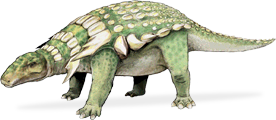
Edmontonia is a nodosaurid ankylosaur, one of the low-slung, four-legged, tank-like herbivores with a shield of armour plates on their skull, back and tail. Compared to ankylosaurid ankylosaurs, nodosaurids were less robust and lacked a thunderous tail club, but they weren't necessarily short-changed. Many sharp spikes along their sides were a decent replacement, and Edmontonia was further fortified with three half-rings made of large keeled plates to protect the back of its neck and shoulders, the latter of which sported the longest spikes.
Palaeontologists have speculated forever about these spikes and their purpose. Were they tools during bouts of "shovey" between rival males? A non-contact "my spikes are bigger than yours" show for intimidation purposes? Or just a good old-fashioned defence against would-be predators? It may be that if females found big spikes incredibly alluring, then Mother Nature simply blessed males with big spikes, which would confirm our suspicions: even in the Late Cretaceous, it was all about the size of male appendages.
In 1971 Walter Coombs referred all confirmed species of Edmontonia to a subgenus within Panoplosaurus, creating Panoplosaurus (Edmontonia) longiceps and Panoplosaurus (Edmontonia) rugosidens. But some experts remained sceptical, and the results of later research by Arbour, Burns and Sissons confirmed that they had every right to be. Although similar in overall size and general proportions, Edmontonia has a more pear-shaped skull than Panoplosaurus, with a longer snout and smooth-surfaced armour, its sacrum consists of one less vertebra (3), the spine and arch of its vertebrae are shorter, and it has larger teeth.
Palaeontologists have speculated forever about these spikes and their purpose. Were they tools during bouts of "shovey" between rival males? A non-contact "my spikes are bigger than yours" show for intimidation purposes? Or just a good old-fashioned defence against would-be predators? It may be that if females found big spikes incredibly alluring, then Mother Nature simply blessed males with big spikes, which would confirm our suspicions: even in the Late Cretaceous, it was all about the size of male appendages.
In 1971 Walter Coombs referred all confirmed species of Edmontonia to a subgenus within Panoplosaurus, creating Panoplosaurus (Edmontonia) longiceps and Panoplosaurus (Edmontonia) rugosidens. But some experts remained sceptical, and the results of later research by Arbour, Burns and Sissons confirmed that they had every right to be. Although similar in overall size and general proportions, Edmontonia has a more pear-shaped skull than Panoplosaurus, with a longer snout and smooth-surfaced armour, its sacrum consists of one less vertebra (3), the spine and arch of its vertebrae are shorter, and it has larger teeth.
Etymology
Edmontonia was named after the Edmonton formation (See discovery). The species epithet, longiceps, is derived from the Latin "longus" (long) and "ceps" (head) because of its... long head.
Discovery
The fossils of Edmontonia longiceps were discovered in the Horseshoe Canyon Formation (formerly the Edmonton Formation) in the Edmonton Group of Alberta, Canada, by George Paterson in 1924. Edmontonia was named 4 years later by C. M. Sternberg.
The holotype (NMC 8531) is a partial skeleton.


