









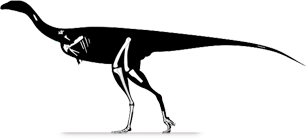
Pronunciation: KEE-yuh-CUR-suh
Meaning: Kiya River runner
Author/s: Averianov et al. (2024)
Synonyms: None known
First Discovery: Western Siberia, Russia
Acta Ordinal: #1168
Kiyacursor longipes
The story of Kiyacursor longipes begins in a place most people don't associate with small, sprint-built theropods: the riverbanks of Western Siberia. The Ilek Formation, with its patchwork of floodplain muds and channel sands, has a habit of preserving the unexpected, and in the summer of 2023 it offered up something that nudged the boundaries of what we thought Asia's Early Cretaceous ecosystems looked like.
The bones—partial vertebrae, a shoulder girdle, an upper arm, and hindlimbs—were catalogued as KOKM 5542. On paper, it's an unassuming specimen number. In practice, it marks the first Early Cretaceous ceratosaur known from Asia, extending the Asian ceratosaur record by 40 million years, and only the second non-bird theropod formally named from Russia, behind Kileskus. Taken together, those facts give the animal a kind of narrative gravity: a small predator almost single-handedly standing in for an entire missing chapter of regional dinosaur history.
The genus name, Kiyacursor, is self-explanatory once you see the proportions. "Runner of the Kiya River" is not poetic license so much as a straightforward anatomical observation. Like all noasaurid ceratosaurs, the legs are long and the build is light, and the overall silhouette—at roughly two and a half metres from snout to tail—suggests an animal that lived by staying quick. What’s interesting is that Kiyacursor didn’t follow the usual "running foot" template seen in other swift theropods like ornithomimids or tyrannosaurs, which evolved the arctometatarsalian foot with a pinched middle metatarsal. Noasaurids took a different path: they thinned the inner metatarsal instead, leaving the middle bone broad and load-bearing—an arrangement that ends up looking more like an ostrich's than a classic arctometatarsalian squeeze, though Kiyacursor still kept all three toes fully functional, unlike the two-toed (didactylous) ostrich. It's a small anatomical detour, but one that shows there was more than one way to engineer a fast-moving theropod.
The bones—partial vertebrae, a shoulder girdle, an upper arm, and hindlimbs—were catalogued as KOKM 5542. On paper, it's an unassuming specimen number. In practice, it marks the first Early Cretaceous ceratosaur known from Asia, extending the Asian ceratosaur record by 40 million years, and only the second non-bird theropod formally named from Russia, behind Kileskus. Taken together, those facts give the animal a kind of narrative gravity: a small predator almost single-handedly standing in for an entire missing chapter of regional dinosaur history.
The genus name, Kiyacursor, is self-explanatory once you see the proportions. "Runner of the Kiya River" is not poetic license so much as a straightforward anatomical observation. Like all noasaurid ceratosaurs, the legs are long and the build is light, and the overall silhouette—at roughly two and a half metres from snout to tail—suggests an animal that lived by staying quick. What’s interesting is that Kiyacursor didn’t follow the usual "running foot" template seen in other swift theropods like ornithomimids or tyrannosaurs, which evolved the arctometatarsalian foot with a pinched middle metatarsal. Noasaurids took a different path: they thinned the inner metatarsal instead, leaving the middle bone broad and load-bearing—an arrangement that ends up looking more like an ostrich's than a classic arctometatarsalian squeeze, though Kiyacursor still kept all three toes fully functional, unlike the two-toed (didactylous) ostrich. It's a small anatomical detour, but one that shows there was more than one way to engineer a fast-moving theropod.
(Long-legged Kiya River Runner)Etymology
Kiyacursor is derived from "kiya" (for the Kiya River) and the Latin "cursor" (runner).The species epithet, longipes, means "long foot", from the Latin "longus" (long) and "pes" (foot) ZooBank registry: urn:lsid:zoobank.org:act:069A4714-3272-4DDF-8B1C-F6038C5ED877.
Discovery
The remains of Kiyacursor were discovered in the Ilek Formation at the Shestakovo 1 locality, along the Kiya River in Kemerovo Oblast (aka Kuzbass), Western Siberia, Russia, by palaeontologists from St. Petersburg State University in the summer of 2023.
The holotype (KOKM 5542, housed at the Kuzbass State Museum of Local Lore) is a partial skeleton including a neck vertebra, neck ribs, tail vertebrae, the left shoulder girdle, an upper arm, and most of both hind limbs.
A partial neck vertebra (PIN 329/16, housed at the Borissiak Paleontological Institute of the Russian Academy of Sciences in Moscow), found by local teacher G.?A. Chudova at the same locality and described in 2023 as part of "a long-necked theropod", most likely belongs to the same individual.


