




Pronunciation: ee-yuh-long
Meaning: Henan Dragon
Author/s: Lü et al. (2013)
Synonyms: None known
First Discovery: Henan, China
Acta Ordinal: #851
Yulong mini
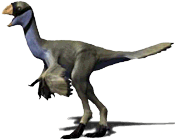
Yulong, meaning "Henan Dragon", is a member of Oviraptoridae—a group of theropod dinosaurs known as "egg snatchers" that did no such thing—and was named in 2013 based on remains from the Late Cretaceous Qiupa Formation in China's Henan Province.
Despite its draconic name that conjures up a mythical beast of immense proportions, Yulong was only about the size of a chicken. Granted, all known specimens at the time of naming were juveniles, and the second critter to officially join the roll call of non-flying dinosaur in 2013 would have been sunk into oblivion if or when an adult version was discovered that had already been named something else. Thankfully, a sub-adult turned up in 2022, which is still one of the smallest known oviraptorosaurs. Still, it was big enough to confirm what the name-coining authors suspected from the start: regardless of their age or size, oviraptorids maintained the same hindlimb proportions, and this kind of isometric growth pattern is more common in herbivores than it is in carnivores.
Oviraptorids have long been regarded as carnivorous, or at least omnivorous, from the moment Oviraptor—the OG egg snatcher—was found loitering in the vicinity of a nest of eggs and accused of bad intentions until palaeontologists realised they were her own. But the proportions of Yulong's legs, the buck-teeth of Incisivosaurus, and the gastroliths (grinding stones) and seeds found within Caudipteryx and Ningyuansaurus all point to herbivory. Though if the odd lizard gets tangled in your swamp weed, what are you gonna do?
Despite its draconic name that conjures up a mythical beast of immense proportions, Yulong was only about the size of a chicken. Granted, all known specimens at the time of naming were juveniles, and the second critter to officially join the roll call of non-flying dinosaur in 2013 would have been sunk into oblivion if or when an adult version was discovered that had already been named something else. Thankfully, a sub-adult turned up in 2022, which is still one of the smallest known oviraptorosaurs. Still, it was big enough to confirm what the name-coining authors suspected from the start: regardless of their age or size, oviraptorids maintained the same hindlimb proportions, and this kind of isometric growth pattern is more common in herbivores than it is in carnivores.
Oviraptorids have long been regarded as carnivorous, or at least omnivorous, from the moment Oviraptor—the OG egg snatcher—was found loitering in the vicinity of a nest of eggs and accused of bad intentions until palaeontologists realised they were her own. But the proportions of Yulong's legs, the buck-teeth of Incisivosaurus, and the gastroliths (grinding stones) and seeds found within Caudipteryx and Ningyuansaurus all point to herbivory. Though if the odd lizard gets tangled in your swamp weed, what are you gonna do?
(Little Henan Dragon)Etymology
Yulong is derived from the Chinese "Yù" (the one-character pinyin abbreviation of Henan Province) and "long" (dragon). The species epithet, mini, refers to its small size. ZooBank registry: urn:lsid:zoobank.org:act:D6B690F2-3E47-4049-8AA0-C48D2001409D.
Discovery
The remains of Yulong were discovered in the Qiupa Formation at Qiupa town, Luanchuan county, Henan Province, China.
The holotype (HGM 41HIII-0107) is an exceptionally well-preserved skeleton, complete with skull and lower jaws.


