
PAMPARAPTOR
a small, meat-eating dromaeosaurid dinosaur from the Late Cretaceous of Argentina.
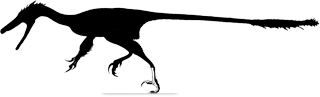
Pronunciation: PAM-pah-RAP-tuhr
Meaning: Pampa plunderer
Author/s: Porfiri
et al. (
2011)
Synonyms: None known
First Discovery: Neuquén Province, Argentina
Acta Ordinal: #769
Pamparaptor micros
(Small Plunderer of the Pampas People)Etymology
Pamparaptor is derived from "Pampa" (in honour of the Indian Pampas that
lived in the central plains of Argentina) and the Latin "raptor" (plunderer, robber, snatcher or thief).
The
species epithet,
micros, means "small" in Latin.
Discovery
The remains of
Pamparaptor were discovered in the Portezuelo Formation (Río Neuquén Subgroup, Neuquén Group) at Baal Quarry on the north coast of Barreales Lake, Neuquén Province, Patagonia, Argentina, by Diego Rosales, a technician for the Lake Barreales Paleontological Center (CePaLB) at the National University of Comahue, in 2005.
The giant lognkosaurian titanosaur
Futalognkosaurus dukei, the dromaeosaurids
Unenlagia comahuensis,
Unenlagia paynemili, and
Neuquenraptor argentinus, the alvarezsaurid
Patagonykus puertai, the megaraptorid
Megaraptor namuhnuaiquii, as
well as abelisaurid remains, undescribed theropods, and fragmentary remains of a possible neornithine bird, all hail from this formation.
The
holotype (MUCPv-1163) is a mostly complete and fully articulated left foot, including the characteristic deinonychosaurian second toe "killing claw", but also the small size and the slender structure typical of troodontids.
In 2007, Porfiri
et al. referred to this specimen as a subadult version of
Neuquenraptor which is known from the same area, but that was before it was fully prepared out of the feature-obscuring rock matrix.
Preparators
The Centro Paleontológico Lago Barreales team.
Estimations
Timeline:
Era: Mesozoic
Epoch: Late Cretaceous
Stage: Turonian-Coniacian
Age range: 94-86 mya
Stats:
Est. max. length: 0.6 meters
Est. max. hip height: 0.2 meters
Est. max. weight: 5 Kg
Diet: Carnivore
References
• Novas FE (1996) "Alvarezsauridae, Cretaceous basal birds from Patagonia and Mongolia". In Novas and Molnar (eds.) "Proceedings of the Gondwanan Dinosaur Symposium".
Memoirs of the Quee.nsland Museum, 39(3): 675-702. [Patagonykus puertai]
• Novas FE and Puerta PF (1997) "New evidence concerning avian origins from the Late Cretaceous of Patagonia".
Nature, 387: 390–392. DOI: 10.1038/387390a0. [Unenlagia comahuensis.]
• Novas FE (1998) "
Megaraptor namunhuaiquii, gen. et sp. nov., a large-clawed, Late Cretaceous theropod from Patagonia".
Journal of Vertebrate Paleontology 18(1): 4-9. March 1998. [Megaraptor namuhnuaiquii.]
• Calvo JO, Porfiri JD and Kellner AWA (2004) "On a new Maniraptoran dinosaur from the Late Cretaceous of Neuquén, Patagonia, Argentina".
Arquivos do Museu Nacional, Rio de Janeiro, 62(4): 549-566. [Unenlagia paynemili.]
• Novas FE and Pol D (2005) "
New Evidence on Deinonychosaurian Dinosaurs from the Late Cretaceous of Patagonia".
Nature, 433(7028): 858-861. [Neuquenraptor argentinus]
• Porfiri JD, Calvo JO, dos Santos C and Juarez Valieri RD (2007) "
New record of Neuquenraptor (Theropoda, Dromaeosauridae) from the Late Cretaceous of Patagonia".
 Ameghiniana., 44(S): 34R.
• Calvo JO, Porfiri JD, Gonzalez-Riga BJ and Kellner AW (2007) "
A new Cretaceous terrestrial Gondwanan ecosystem and the description of a new sauropod".
Anais da Academia Brasileira de Ciências, 79(3): 529-541. [Futalognkosaurus.]
• Porfiri JD, Calvo JO and dos Santos D (2011)
"A new small deinonychosaur (Dinosauria: Theropoda) from the Late Cretaceous of Patagonia".
Anais da Academia Brasileira de Ciências, 83(1): 109-116. [*Image Credit*]
• Molina-Pérez R and Larramendi A (2016) "
Encyclopedia of Dinosaurs: The Theropods" [aka Dinosaur Facts and Figures: The Theropods and other Dinosauriformes].
Time stands still for no man, and research is ongoing. If you spot an error, or want to expand, edit or add a dinosaur, please use
this form. Go
here to contribute to our FAQ.
All dinos are GM free, and no herbivores were eaten during site construction!
To cite this page:
Atkinson, L.
"
PAMPARAPTOR :: from DinoChecker's dinosaur archive".
‹
http://www.dinochecker.com/dinosaurs/PAMPARAPTOR›. Web access: 07th Oct 2026.









