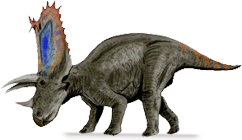
PENTACERATOPS
a plant-eating chasmosaurine ceratopsid dinosaur from the Late Cretaceous of North America.
Pronunciation: PEN-ta-SEH-ruh-tops
Meaning: Five horn face
Author/s: Osborn (
1923)
Synonyms: See
below
First Discovery: New Mexico, USA
Acta Ordinal: #138
Pentaceratops sternbergi
Pentaceratops fenestratus (Wiman, 1930)
Titanoceratops ouranos? (Longrich, 2011)
(Sternberg's five horn face)
Etymology
Pentaceratops is derived from the Greek "Pente" (five), "ceras" (horn) and "ops" (face), alluding to its five-horned face.
Pentaceratops only had three "proper" horns: two on its brow and one on its snout. The other two, as in all ceratopsids and some other ceratopsians, were merely bony projections, one on each cheek. The
species epithet,
sternbergii, honours Charles Hazelius Sternberg.
Discovery
The first fossils of
Pentaceratops were recovered from the Fruitland Formation, San Juan Basin, New Mexico by Charles Hazelius Sternberg in 1922. By the way, despite its history as part of the "New Spain"—conveniently "forgetting" that Native Americans tribes were there centuries earlier—the extreme northeast of New Mexico was originally ruled by France, and was sold to the United States as part of the Louisiana Purchase in 1803. The
holotype (AMNH 6325) is an incomplete skull.
Estimations
Timeline:
Era: Mesozoic
Epoch: Late Cretaceous
Stage: Campanian
Age range: 80-73 mya
Stats:
Est. max. length: 5.5 meters
Est. max. hip height: 2.4 meters
Est. max. weight: 2.5 tons
Diet: Herbivore
Pentaceratops aquilonius
Longrich named
Pentaceratops aquilonius in 2014 for a juvenile frill (CMN 9813), collected in 1937 from the Lethbridge Coal Zone near Manyberries, Alberta, by C. M. Sternberg, who attributed it to Anchiceratops a dozen years later, and a paratype frill fragment (CMN 9814) from a much older specimen found 16 km away from the holotype site. The latter, according to Mallon, was misidentified and, when positioned correctly, closely matched the corresponding piece on the frill of
Spiclypeus shipporum. Given the many changes that occur within ceratopsian frills with each growth stage, it is plausible that the holotype juvenile frill could have changed with age to more closely resemble the paratype, in which case it would belong to
Spiclypeus too. But it's just as plausible that it might not have, and because of its poor quality material,
Pentaceratops aquilonius was chalked off as a nomen dubium.
References
• Osborn HF (1923) "
A new genus and species of Ceratopsia from New Mexico".
American Museum Novitates, 93: 1-3
• Sternberg CM (1949) "The Edmonton fauna and description of a new
Triceratops from the Upper Edmonton member; phylogeny of the Ceratopsidae".
Natl Mus Can Bull. 113: 33–46
• Rowe T, Colbert EH and Nations JD (1981) "The occurrence of Pentaceratops with a description of its frill".
Page 29-48 in Lucas, Rigby and Kues (eds.) "Advances in San Juan Basin Paleontology".
• Lehman TM (1998) "A gigantic skull and skeleton of the horned dinosaur
Pentaceratops sternbergi from New Mexico".
Journal of Paleontology, 72(5): 894-906.
• Dodson P (1996) "
The Horned Dinosaurs: a Natural History".
• Ryan MJ, Chinnery-Allgeie BJ and Eberth DA (2010) "
New Perspectives on Horned Dinosaurs: The Royal Tyrrell Museum Ceratopsian Symposium".
• Longrich NR (2014) "The horned dinosaurs
Pentaceratops and
Kosmoceratops from the upper Campanian of Alberta and implications for dinosaur biogeography".
Cretaceous Research, 51: 292–308.
• Paul GS (2010) "
The Princeton Field Guide to Dinosaurs".
• Sullivan RM and Lucas SG (2011) "Charles Hazelius Sternberg and his San Juan Basin Cretaceous dinosaur collections: Correspondence and photographs (1920-1925)".
New Mexico Museum of Natural History and Science Bulletin 53: 429-471.
• Mallon JC, Ott CJ, Larson PL, Iuliano EM, Evans DC (2016) "
Spiclypeus shipporum gen. et sp. nov., a Boldly Audacious New Chasmosaurine Ceratopsid (Dinosauria: Ornithischia) from the Judith River Formation (Upper Cretaceous: Campanian) of Montana, USA".
PLoS ONE 11(5): e0154218. DOI: 10.1371/journal.pone.0154218
• Longrich NR (2011) "
Titanoceratops ouranos, a giant horned dinosaur from the Late Campanian of New Mexico".
Cretaceous Research, 32(3): 264–276. DOI: 10.1016/j.cretres.2010.12.007
• Fowler DW and Freedman Fowler EA (2020) "
Transitional evolutionary forms in chasmosaurine ceratopsid dinosaurs: evidence from the Campanian of New Mexico".
PeerJ 8:e9251 DOI: 10.7717/peerj.9251
Time stands still for no man, and research is ongoing. If you spot an error, or want to expand, edit or add a dinosaur, please use
this form. Go
here to contribute to our FAQ.
All dinos are GM free, and no herbivores were eaten during site construction!
To cite this page:
Atkinson, L.
"
PENTACERATOPS :: from DinoChecker's dinosaur archive".
‹
http://www.dinochecker.com/dinosaurs/PENTACERATOPS›. Web access: 25th Oct 2026.