









Pronunciation: AHR-uh-go-SOR-us
Meaning: Aragon lizard
Author/s: Sanz, Buscalioni, et al. (1987)
Synonyms: None known
First Discovery: Aragon, Spain
Acta Ordinal: #335
Aragosaurus ischiaticus
The Españoles have had a rough trot trying to find unique-to-Spain dinosaurs. Oftentimes, they thought they'd bagged one, then it went and got itself discovered elsewhere... first. But their hearts were gladdened when Aragosaurus—found in Aragon in 1958 but long thought to be a specimen of Camarasaurus—was confirmed as a unique critter and thus became the first exclusively Spanish dinosaur.
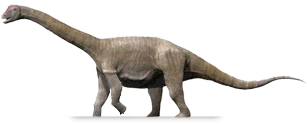
Aragosaurus fossils aren't brilliant, but judging from the known bits it probably had a short and compact skull on a medium-long neck, wide chisel-like teeth for chomping tough conifers, a long muscular tail, and an almost level body because its hindlimbs were only slightly longer than its forelimbs. It's broadly Camarasaurus-like, in fact, which is why Lapparent classified it as a camarasaurid way back in 1960, though he refrained from officially naming it at that time and referred to it only as "the sauropod from Las Zabacheras". The latest research has Aragosaurus pegged as a non-titanosaurid macronarian, possibly forming a group called Laurasiformes, along with Lourinhasaurus and Tastavinsaurus.
Aragosaurus fossils aren't brilliant, but judging from the known bits it probably had a short and compact skull on a medium-long neck, wide chisel-like teeth for chomping tough conifers, a long muscular tail, and an almost level body because its hindlimbs were only slightly longer than its forelimbs. It's broadly Camarasaurus-like, in fact, which is why Lapparent classified it as a camarasaurid way back in 1960, though he refrained from officially naming it at that time and referred to it only as "the sauropod from Las Zabacheras". The latest research has Aragosaurus pegged as a non-titanosaurid macronarian, possibly forming a group called Laurasiformes, along with Lourinhasaurus and Tastavinsaurus.
Etymology
Aragosaurus is derived from "Aragon" (the region of Spain in which it was discovered) and the Greek "sauros" (lizard). The species epithet, ischiaticus, means "of the ischium" in Latin, referring to the features of this hip bone. ZooBank registry: urn:lsid:zoobank.org:act:EC914269-53D0-42B9-ACE7-B347D88E01FB.
Discovery
The first fossils of Aragosaurus were discovered at the Las Zabacheras site in Galve, Teruel Province, southern Aragón, northeastern Spain, by amateur paleontologist José María Herrero Marzo in 1958. They were found in the embankment of "the old road to Galve", which was constructed in 1934 but is now mostly buried beneath landfill and rubble. Although traditionally placed in the El Castellar Formation (in the lower part of the Wealden facies), Royo-Torres et al. announced in 2009 that Las Zabacheras lay within the Villar del Arzobispo Formation, which would make Aragosaurus almost 15 million years older than previously thought. In 2012, Canudo et al. convincingly showed that this was not the case. In 2018, Santos et al., just as convincingly, argued that it was.
The holotype (ZN-1 to ZN-19) includes caudal (tail) vertebrae, chevrons, a shoulder blade, a forelimb, bits of the hip, a thigh bone, several fingers, and a claw.


