




Pronunciation: ah-REN-ee-SOR-us
Meaning: Aren lizard
Author/s: Pereda-Suberbiola et al. (2009)
Synonyms: None known
First Discovery: Huesca, Spain
Acta Ordinal: #673
Arenysaurus ardevoli
As the 20th century grew to a close, Spain's record of exclusively Spanish fossil dinosaurs was a bit embarrassing. It's not like they were short of remains. It's just that most of them either lay unprepared or were non-diagnostic, and the ones that bucked those trends turned out to be synonymous with other dinosaurs that had already been found elsewhere first. However, things began to look up in the earliest part of the 21st century, and since then, Spain has become something of a hotspot for European dinosaurs, some of which were real headline-makers.
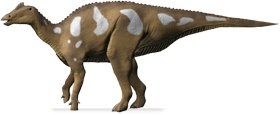
Arenyasaurus, for example, owns the first articulated lambeosaurine hadrosaurid skull known from Europe, albeit a partial one. Although occupying a somewhat basal position in Lambeosaurinae, its Late Maastrichtian age makes Arenyasaurus the last member of this family currently known from Europe too, and as a giant asteroid was just a stones-throw away from striking Earth and sparking a catastrophic chain of events that would wipe out all non-bird dinosaurs worldwide at that point, the chances of finding a later-living one are slim.
In 2015, Arenyasaurus became the first European hadrosaurid to have its endocast and inner ear CT-scanned and reconstructed in 3D. The structure of the inner ear can dictate the movement of the eyes and head, while the brain cavity can yield information to tie its owner to a particular family, subfamily, or even species. But such scans can also reveal age and stage of development, and a puzzling combination of sub-adult neural features and fully grown skeletal features suggest Arenyasaurus may have been a dwarf.
Arenyasaurus, for example, owns the first articulated lambeosaurine hadrosaurid skull known from Europe, albeit a partial one. Although occupying a somewhat basal position in Lambeosaurinae, its Late Maastrichtian age makes Arenyasaurus the last member of this family currently known from Europe too, and as a giant asteroid was just a stones-throw away from striking Earth and sparking a catastrophic chain of events that would wipe out all non-bird dinosaurs worldwide at that point, the chances of finding a later-living one are slim.
In 2015, Arenyasaurus became the first European hadrosaurid to have its endocast and inner ear CT-scanned and reconstructed in 3D. The structure of the inner ear can dictate the movement of the eyes and head, while the brain cavity can yield information to tie its owner to a particular family, subfamily, or even species. But such scans can also reveal age and stage of development, and a puzzling combination of sub-adult neural features and fully grown skeletal features suggest Arenyasaurus may have been a dwarf.
(Ardevol's Aren lizard)Etymology
Arenysaurus is derived from "Arén" (known as "Areny de Noguera" in Catalan; a village in Huesca Province, Spain, close to where its fossils were found) and the Greek "sauros" (lizard).The species epithet, ardevoli, honours geologist Lluis Ardèvol who discovered the Blasi sites.
Discovery
The remains of Arenysaurus were discovered at the "Blasi 3" site in the lower part of the Tremp Formation, near Arén village in the South-central Pyrenees Mountains, Huesca Province, Aragorn, Spain.
The holotype (MPZ 2008/1) is a partial skull comprising
the skull roof and braincase.


