









Pronunciation: DEE-long
Meaning: Emperor dragon
Author/s: Xu et al. (2004)
Synonyms: None known
First Discovery: Liaoning, China
Acta Ordinal: #563
Dilong paradoxus
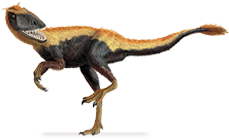
Upon discovery, Dilong was the oldest known unquestionable tyrannosauroid. It's one of the most complete early "tyrant lizards" too, and had an abundance of unusual features, the most newsworthy of which was the first direct fossil evidence that tyrannosauroids were feathered. They weren't like the feathers you would find on modern birds, but bristly fibres or "proto-feathers", and they covered its entire body. Not so newsworthy was a unique Y-shaped crest formed by the lacrimals (bones that form the front of the eye socket) and nasals (bones that form the roof of the snout).
Typically of early tyrannosauroids, the coelurosaurian dinosaur lineage that led to the Late Cretaceous tyrannosaurid, Tyrannosaurus rex, Dilong is small and gracile with a long and shallow snout and relatively long arms with three-fingered hands. Unlike the larger and more advanced tyrannosaurids, its bones are less aero-textured, and its paired pubis bones are more slender but end with an enormous bony boot. The hindlimb proportions suggest Dilong was a decent runner, but it wasn't as fast as similar-sized tyrannosauroids due to shorter lower legs. Its shoulder blades are unusually robust.
In a 2014 study, Dilong paradoxus, along with Proceratosaurus bradleyi, Kileskus aristotocus, Guanlong wucaii, Sinotyrannus kazuoensis, Juratyrant langhami and Stokesosaurus clevelandi, was found to be a proceratosaurid tyrannosauroid.
Typically of early tyrannosauroids, the coelurosaurian dinosaur lineage that led to the Late Cretaceous tyrannosaurid, Tyrannosaurus rex, Dilong is small and gracile with a long and shallow snout and relatively long arms with three-fingered hands. Unlike the larger and more advanced tyrannosaurids, its bones are less aero-textured, and its paired pubis bones are more slender but end with an enormous bony boot. The hindlimb proportions suggest Dilong was a decent runner, but it wasn't as fast as similar-sized tyrannosauroids due to shorter lower legs. Its shoulder blades are unusually robust.
In a 2014 study, Dilong paradoxus, along with Proceratosaurus bradleyi, Kileskus aristotocus, Guanlong wucaii, Sinotyrannus kazuoensis, Juratyrant langhami and Stokesosaurus clevelandi, was found to be a proceratosaurid tyrannosauroid.
(Emperor dragon with suprising features)Etymology
Dilong is derived from the Chinese "di" (emperor) referring to this animals relationship to Tyrannosaurus rex, the "king" of the tyrant lizards, and "long" (dragon) which is assigned to Chinese dinosaurs the same way as the Greek "sauros" is in the West.The species epithet, paradoxus, is derived from the Ancient Greek "paradoxos" (contrary to expectation) and refers to its unusual features.
Discovery
The first fossils of Dilong were discovered in the Lower Cretaceous Yixian Formation near Lujiatun Village, Beipiao, western Liaoning province, China.
The holotype (IVPP 14243, housed at Beijing's Institute of Vertebrate Paleontology and Paleoanthropology) is a semi-articulated skeleton and an almost complete skull.
Referred specimens include IVPP 1242 (a nearly complete skull and presacral vertebrae) and TNP01109 (a partial skull). Another skull (IVPP V11579), found at Zhangjiagou, may belong to Dilong or a closely related species.


