









Pronunciation: URBAC tooth
Meaning: Averianov and Sues
Author/s: None known (2007)
Synonyms: None known
First Discovery: Itemir, Uzbekistan
Acta Ordinal: #632
Urbacodon itemirensis
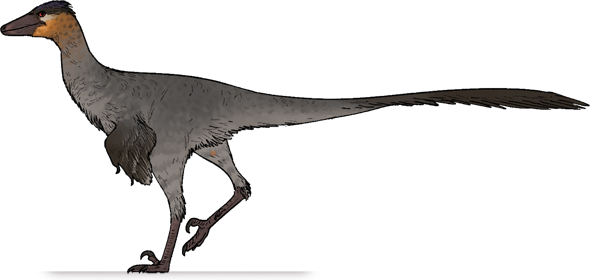
Urbacodon fossils are a bit thin on the ground, with the only confirmed remains to date being a lower left jaw bone (known as the dentary), 79.2 mm long, containing thirty two un-serrated teeth. But a fossil is a fossil, and when it was fed into the mystical clade-machine it spat out a slip that read 'Troodontidae' which was a little suprising.
Barring Byronosaurus, Xixiasaurus, Mei, Anchiornis, and a few other discoveries that may just be hatchlings, troodontids are reknowned for their serrated teeth. They mostly have a slightly curved lower jaw too, but Urbacodon's was rather straight, which palaeontologists have interpreted as quite a primitive feature.
Based on it's dental features, Urbacodon seems closest to Byronosaurus, and these two, along with Xixiasaurus, may form their own gang within Troodontidae because they are all Late Cretaceous, smooth-toothed and Asian.
Barring Byronosaurus, Xixiasaurus, Mei, Anchiornis, and a few other discoveries that may just be hatchlings, troodontids are reknowned for their serrated teeth. They mostly have a slightly curved lower jaw too, but Urbacodon's was rather straight, which palaeontologists have interpreted as quite a primitive feature.
Based on it's dental features, Urbacodon seems closest to Byronosaurus, and these two, along with Xixiasaurus, may form their own gang within Troodontidae because they are all Late Cretaceous, smooth-toothed and Asian.
Etymology
Urbacodon is derived from "Urbac" (an acronym honouring the the scientists of Uzbekistan, Russia, Britain, America and Canada, who participated in joint expeditions to the Kyzylkum Desert) and the Greek "odon" (tooth).
The species epithet, itemirensis, is derived from "Itemir" (the locality) and the Latin "ensis" (from).
Discovery
The remains of Urbacodon were discovered at Site IT-01 of the Itemir locality, Dzharakuduk Formation, Kyzylkum Desert in Uzbekistan, by Anton S. Rezvyi on September 9th, 2004.
The holotype (ZIN PH 944/16 - housed at the Zoological
Institute, Russian Academy of Sciences) is a left tooth bearing bone of the lower jaw (dentary).
Other species
Urbacodon norelli (Wang et al. 2024)


