





Pronunciation: TAY-luhs
Meaning: Talos (see etymology)
Author/s: Zanno et al. (2010)
Synonyms: None known
First Discovery: Utah, USA
Acta Ordinal: #799
Talos sampsoni
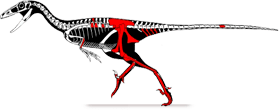
Talos was small and gracile, even by troodontid standards, and represents one of the most complete troodontid skeletons described from North America to date, and the first definitive Late Cretaceous North American troodontid to be named in over 75 years.
As well as small feathered bodies, troodontids are renowned for their relatively large brains which plonked them among the brightest non-avian dinosaurs. A smashed second-toe-talon on the type specimen of Talos, damaged either during an attack on prey, a table-turning retaliation by the prey, or an attack from another dinosaur that looked upon it as prey, was the result of recklessness, stupidity or bad fortune. But either way, it lived to eat another day, albeit with a nasty infection that never fully healed before death.
Talos was notably smaller than its well known relative Troodon (the only other North American troodontid known from decent remains) and its unique form adds another 30kg to the theory that its home—the southern part of the island of Laramidia (separated from Appalachia to the east by the Western Interior Seaway)—was split horizontally by some form of natural barrier which allowed species either side of it to evolve their own distinct quirks.
As well as small feathered bodies, troodontids are renowned for their relatively large brains which plonked them among the brightest non-avian dinosaurs. A smashed second-toe-talon on the type specimen of Talos, damaged either during an attack on prey, a table-turning retaliation by the prey, or an attack from another dinosaur that looked upon it as prey, was the result of recklessness, stupidity or bad fortune. But either way, it lived to eat another day, albeit with a nasty infection that never fully healed before death.
Talos was notably smaller than its well known relative Troodon (the only other North American troodontid known from decent remains) and its unique form adds another 30kg to the theory that its home—the southern part of the island of Laramidia (separated from Appalachia to the east by the Western Interior Seaway)—was split horizontally by some form of natural barrier which allowed species either side of it to evolve their own distinct quirks.
(Sampson's talon)
Etymology
Talos is named after... Talos, the giant bronze sentinel from Greek mythology who had a single vein running the length of his body and a pin-plug on his ankle that kept his life force in. The story goes; Talos was created by Hephaestos at the behest of Zeus and plonked on Crete to protect his latest squeeze, Europa. When Jason rocked up with his fleecing Argonauts, Medea sang him to sleep, then removed the pin which drained his lifeforce and rendered him nothing more than a pile of scrap metal. Talos the troodontid also has a damaged foot, which is part of the reason for its name. The other part is a play on the English word "talon" (a sharply hooked claw) because troodontids had one on the second toe of each foot.
The species epithet, sampsoni, honours paleontologist Dr. Scott D. Sampson.
ZooBank registry: urn:lsid:zoobank.org:act:963F60E2-4BCF-43EC-9C39-1BC81BE51AD8.
Discovery
The remains of Talos were discovered in the Kaiparowits Formation within Utah's Grand Staircase-Escalante National Monument by M. J. Knell during the University of Utah's Kaiparowits Basin Project in 2008. The holotype (UMNH VP 19479) is the partial, skull-less skeleton of a subadult individual including the handlimbs, pelvis, fragments of vertebrae, chevrons, and the left ulna (one of two forearm bones).


