




Pronunciation: HOO-dyeh-SOR-us
Meaning: Butterfly lizard
Author/s: Dong (1997)
Synonyms: None known
First Discovery: Xinjiang, China
Acta Ordinal: #427
Hudiesaurus sinojapanorum
Upon discovery, Zhiming Dong announced Hudiesaurus as "a gigantic sauropod" and chose a name that means... butterfly lizard. However, he had not taken leave of his senses. The name has nothing to do with its size or general appearance, but refers to the "wing-like process on the neural spine of the anterior dorsal vertebra" (a wing-shaped outgrowth on the top part of the back vertebra closest to its neck), and while its remains are undeniably huge, even by sauropod standards, there ain't a lot of them.
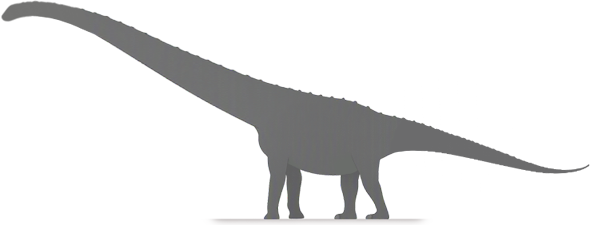
Hudiesaurus is known from one vertebra. Yep, just the one. Granted it's a whopper, reputedly 1.5 times wider than the corresponding bone of Mamenchisaurus hochuanensis which is around 22 meters long from nose to tail-tip. So, assuming they are related and similarly proportioned, Hudiesaurus could have been 33 meters in length.
As impressive as this sounds, mamenchisaurids are around 50% neck and proportionately small-bodied, so while very long they're not that heavy. On top of that, the vertebra of Hudiesaurus may actually be from its neck, which are much wider than those from the back, in which case its total length would be a lot less spectacular.
All that being said, Hudiesaurus is far from a shoo-in mamenchisaurid but this is where the lions share of poorly-represented Chinese sauropods tend to end up. A rustic arm (IVPP V11121-1) and four teeth (IVPP V11121-2) that Dong also assigned to Hudiesaurus could have helped with its classification, but they're not from the same individual or even the same quarry! Heck, some paleontologists thought they may belong to a different kind of critter entirely, and that proved to be the case when Paul Upchurch used the arm to anchor Rhomaleopakhus turpanensis in 2021.
Hudiesaurus is known from one vertebra. Yep, just the one. Granted it's a whopper, reputedly 1.5 times wider than the corresponding bone of Mamenchisaurus hochuanensis which is around 22 meters long from nose to tail-tip. So, assuming they are related and similarly proportioned, Hudiesaurus could have been 33 meters in length.
As impressive as this sounds, mamenchisaurids are around 50% neck and proportionately small-bodied, so while very long they're not that heavy. On top of that, the vertebra of Hudiesaurus may actually be from its neck, which are much wider than those from the back, in which case its total length would be a lot less spectacular.
All that being said, Hudiesaurus is far from a shoo-in mamenchisaurid but this is where the lions share of poorly-represented Chinese sauropods tend to end up. A rustic arm (IVPP V11121-1) and four teeth (IVPP V11121-2) that Dong also assigned to Hudiesaurus could have helped with its classification, but they're not from the same individual or even the same quarry! Heck, some paleontologists thought they may belong to a different kind of critter entirely, and that proved to be the case when Paul Upchurch used the arm to anchor Rhomaleopakhus turpanensis in 2021.
(Butterfly lizard)
Etymology
Hudiesaurus is derived from the Chinese "hudie" (butterfly), for "the wing-like process on the neural spine of the anterior dorsal vertebra", and the Greek "sauros" (lizard). The species epithet, sinojapanorum (SIE-noh-JAP-a-NOR-um), means "of the Chinese and Japanese" in Latin and refers to the nationalities of the members of the expedition that found the specimen.
Discovery
The remains of Hudiesaurus were discovered in the Kalazha Formation, Turpan, Xinjiang, China, during the Sino-Japanese Silk Road dinosaur expedition in 1992/3.
The holotype (IVPP V 11120) is a single, very large vertebra. Dong also referred an almost complete right arm (IVPP V11121-1) and four poorly-preserved teeth (IVPP V11121-2) to Hudiesaurus too, despite them coming from a quarry 1.1 km away from the type specimen and having no anatomical overlap between them. The arm was used by Upchurch to anchor Rhomaleopakhus turpanensis in 2021.


