









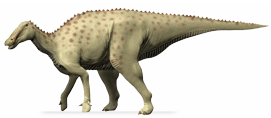
Pronunciation: PAR-a-RAB-do-don
Meaning: near Rhabdodon
Author/s: Casanovas-Cladellas (1993)
Synonyms: Koutalisaurus kohlerorum?
First Discovery: Lleida, Spain
Acta Ordinal: #385
Pararhabdodon isonensis
When palaeontologists found the remains of what would eventually become Pararhabdodon isonensis at "Sant Romà d'Abella" in 1985, they thought it was an iguanodontid closely related to Rhabdodon, and that's where it was asssigned, as Rhabdodon sp, by Casanovas and colleagues in 1987. As excavations progressed over the coming years at this and other Tremp Formation sites, the features of an upper jaw and limb bones suggested that they belonged to a hadrosaurid instead, and it was given its own name — Pararhabdodon isonense — in 1993. Laurent et al. amended the epithet to isonensis in 1997, to match the gender of the generic name: Pararhabdodon is
masculine, whereas isonense is feminine.
Since then, Pararhabdodon has been classified as a lambeosaurine, a non-hadrosaurid hadrosauroid, and lately an advanced tsintaosaurinin, while Rhabdodon turned out to be a more archaic critter, loitering way down at the base of the iguanodont branch of ornithopod dinosaurs. Ergo, despite the name — meaning "near (as in close to or beside) Rhabdodon", the only thing that makes the pair "close" is the country in which they were discovered (Spain), and even that is contentious. Their respective quarry's aren't even close to each other. Nor are the various sites which have yielded Pararhabdodon fossils, and some experts suspect that "its" remains might be a chimera of several species.
Since then, Pararhabdodon has been classified as a lambeosaurine, a non-hadrosaurid hadrosauroid, and lately an advanced tsintaosaurinin, while Rhabdodon turned out to be a more archaic critter, loitering way down at the base of the iguanodont branch of ornithopod dinosaurs. Ergo, despite the name — meaning "near (as in close to or beside) Rhabdodon", the only thing that makes the pair "close" is the country in which they were discovered (Spain), and even that is contentious. Their respective quarry's aren't even close to each other. Nor are the various sites which have yielded Pararhabdodon fossils, and some experts suspect that "its" remains might be a chimera of several species.
(Near Rhabdodon from Isona)Etymology
Pararhabdodon is derived from the Greek "para" (near) and "Rhabdodon" (fluted tooth), named for its proposed close affinities to Rhabdodon.
The species epithet, isonensis, is derived from "Isona" (the municipality close to its place of discovery) and the Latin "ensis" (from). ZooBank registry: urn:lsid:zoobank.org:act:EEC16BA9-8043-4DC5-81C9-309D74E3741C.
Synonyms
Koutalisaurus kohlerorum? (Prieto-Marquez, 2006)
Discovery
The remains of Pararhabdodon were discovered at Sant Romà d'Abella in the Tremp Formation near Isona, Lleida, Spain, by a team from the "Museu de l'Institut de Paleontologia Miquel Crusafont" in the spring of 1985.
The holotype (IPS-SRA 1) is a neck vertebra. The paratype (PS SRA 15-16, 18) is a left humerus, a fragment of shoulder blade and another neck vertebra.
Referred specimens include MCD 4730, IPS SRA 25 and IPS SRA 18 (neck vertebrae), IPS SRA 13, MCD 4731, IPS 693-13, IPS SRA 12 and IPS SRA 20 (back vertebrae), IPS SRA 17 (a tail vertebra), IPS SRA 22 (a right maxilla—the tooth bearing bone of the upper jaw), IPS SRA 23 (part of a left maxilla), IPS SRA 24 (a nearly complete sacrum—a block of hip vertebrae), IPS 693-12 (a rib fragment) and IPS SRA 26 (a partial ischium—a bone from the hip).


