









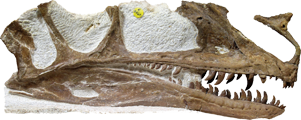
Pronunciation: PRO-suh-RAT-o-SOR-us
Meaning: Before Ceratosaurus
Author/s: von Huene (1910)
Synonyms: Megalosaurus bradleyi
First Discovery: Minchinhampton, England
Acta Ordinal: #152
Proceratosaurus bradleyi
Discovered whilst digging a reservoir at Minchinhampton near Stroud in 1900, Proceratosaurus was originally named Megalosaurus Bradleyi by Arthur Smith Woodward in 1910. It received its current name, formally, in 1926 courtesy of Friedrich von Huene, who assumed it was a primitive and lightweight ancestor of Ceratosaurus because of a similar horn attached to the snout of its lightly built skull, so he pre-fixed that name with the Greek "pro", meaning "before". Huene actually coined Proceratosaurus in 1923. But it lacked a formal description to make it official, and it took him three years to write one.
Barring a quick 1988 outing as a relative of Ornitholestes with Greg Paul, based on the presence of a similar "horn" that turned out to be just a stray bone from the Bird Robbers' terribly mangled snout, Proceratosaurus languished in the dungeons of London's Natural History Museum until 2009 when Rauhut, Milner and Moore-Fay, armed with new-fangled scanning technology, made a startling breakthrough: Proceratosaurus is a primitive tyrannosauroid, the earliest known ancestor of T.rex, and close enough to China's Guanlong to place them both in a raised-for-the-occasion family called Proceratosauridae. Kileskus, Sinotyrannus, Juratyrant, and Stokesosaurus were also assigned there by Loewen et al. in 2013.
Being known only from a partial skull means size estimations are fraught with danger, but a ballpark length of three meters seems reasonable. What is more certain is that Proceratosaurus was in possession of a "Swiss army mouth" with a broader range of teeth for different uses than any other theropod (but bone-crushers weren't among them), and its new classification pushed the origin of "Tyrant Lizards" way back into the Middle Jurassic.
Barring a quick 1988 outing as a relative of Ornitholestes with Greg Paul, based on the presence of a similar "horn" that turned out to be just a stray bone from the Bird Robbers' terribly mangled snout, Proceratosaurus languished in the dungeons of London's Natural History Museum until 2009 when Rauhut, Milner and Moore-Fay, armed with new-fangled scanning technology, made a startling breakthrough: Proceratosaurus is a primitive tyrannosauroid, the earliest known ancestor of T.rex, and close enough to China's Guanlong to place them both in a raised-for-the-occasion family called Proceratosauridae. Kileskus, Sinotyrannus, Juratyrant, and Stokesosaurus were also assigned there by Loewen et al. in 2013.
Being known only from a partial skull means size estimations are fraught with danger, but a ballpark length of three meters seems reasonable. What is more certain is that Proceratosaurus was in possession of a "Swiss army mouth" with a broader range of teeth for different uses than any other theropod (but bone-crushers weren't among them), and its new classification pushed the origin of "Tyrant Lizards" way back into the Middle Jurassic.
(Bradley's Before Horned lizard)Etymology
Proceratosaurus is derived from the Greek "pro-" (before), "ceras" (horn) and "sauros" (lizard), on the initial assumption that its similarly horned snout and Mid-Jurassic age made it directly ancestral to Ceratosaurus, the "horned lizard" from the Late Jurassic.
The species epithet, bradleyi, honours fossil collector F. Lewis Bradley.
Discovery
The remains of Proceratosaurus were discovered in the White Limestone Formation (Great Oolite Group) at Minchinhampton reservoir, near Stroud, Gloucestershire, England, by F. Lewis Bradley in 1900. The holotype (BMNH R4860) is a partial skull.


