









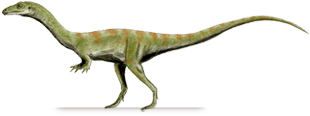
Pronunciation: SHOO-vo-SOR-us
Meaning: Shuvo's lizard
Author/s: Chatterjee (1993)
Synonyms: Chatterjeea (Long & Murry, 1995)
First Discovery: Texas, USA
Acta Ordinal: #
Shuvosaurus inexpectatus
Upon discovery, Shuvosaurus was deemed by Sankar Chatterjee to be an ornithomimid — one of the ostrich-like "bird mimics" from the Cretaceous period — due mainly to the features of its partial skull. But many paleontologists were perplexed because it hailed from a Texan Formation that they recognised as Triassic in age, which would push the origin of these turbo-charged, vegetarian theropods back the odd hundred million years.
In early, unpublished studies, this dinosaur was referred to as "Revueltoraptor lucasi" but never received an official description so remained a nomen nudum. However, this dinosaur isn't a dinosaur. And neither is "Revueltoraptor lucasi," for that matter.
After re-discovering Effigia in an unopened plaster jacket at the AMNH where it had been patiently waiting since 1947, Nesbitt and Norell realised that some suchian archosaurs had unusual, highly specialized features, particularly in the skull, that are identical to those of ornithomimid dinosaurs, and that Shuvosaurus was more closely related to crocodilians. They chalked off any similarities it shared with dinosaurs as the result of convergent evolution, and shunted Shuvosaurus into Archosauria, where it would eventually anchor its own family, Shuvosauridae, and it took the synonymous Chatterjeea elegans with it.
In early, unpublished studies, this dinosaur was referred to as "Revueltoraptor lucasi" but never received an official description so remained a nomen nudum. However, this dinosaur isn't a dinosaur. And neither is "Revueltoraptor lucasi," for that matter.
After re-discovering Effigia in an unopened plaster jacket at the AMNH where it had been patiently waiting since 1947, Nesbitt and Norell realised that some suchian archosaurs had unusual, highly specialized features, particularly in the skull, that are identical to those of ornithomimid dinosaurs, and that Shuvosaurus was more closely related to crocodilians. They chalked off any similarities it shared with dinosaurs as the result of convergent evolution, and shunted Shuvosaurus into Archosauria, where it would eventually anchor its own family, Shuvosauridae, and it took the synonymous Chatterjeea elegans with it.
(Shuvo's unexpected lizard)Etymology
Shuvosaurus is derived from "Shuvo" (for the son of Sankar Chaterjee who discovered, cleaned and prepared its remains) and the Greek "sauros" (lizard).
The species epithet, inexpectatus (in-ecks-peck-TAY-tus), refers to the unexpected nature of its discovery. No one expected to find a "bird mimic" in Triassic deposits and, as already mentioned, they didn't.
Discovery
The remains of this "is it/isn't it?" dinosaur were discovered at Miller's Ranch Quarry in the Cooper Canyon Formation (Dockum group) of Texas, USA, in 1993.The holotype (TTU P 9280) represents the whole left side and part of the right side of an articulated skull, including a braincase fragment.


