




Pronunciation: skoo-TELL-o-SOR-us
Meaning: Small-shield lizard
Author/s: Colbert (1981)
Synonyms: None known
First Discovery: Arizona, USA
Acta Ordinal: #296
Scutellosaurus lawleri
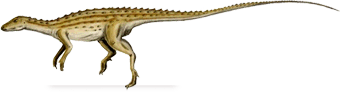
Not to be confused with Scutosaurus (shield lizard), a genus of armour-covered pareiasaur that lived around 250 million years ago in Russia, Scutellosaurus (small-shield lizard) is an armour-covered thyreophoran dinosaur hailing from the early Jurassic Kayenta Formation of Arizona. Colbert initially described it as a member of Fabrosauridae, which has since been disbanded, but also suspected it could be ancestral to ankylosaurs and stegosaurs, and he was dead right. But regarding its mode of locomotion, he was dead wrong.
When he described Scutellosaurus in 1981, Colbert suggested the length of its "arms" and the size of its "hands" compared to the obligate biped Lesothosaurus diagnosticus were indicative of a critter that was more than comfortable on all fours, and indeed that might have been its preferred mode of locomotion, given the head-to-tail armour scutes, studs and knobbly bits that pushed its weight up to a whopping 14kg. However, in 2014, Maidment and Barrett tested that hypothesis based on five anatomical features identified as robust indicators of quadrupedality, and it was found wanting. Furthermore, a model of Scutellosaurus was computed without armour, with its own armour, and with the armour of Stegosaurus and Euoplocephalus to see if the extra weight moved the centre of mass forward and forced the use of forelimbs for support. It didn't. In fact, it moved the centre of mass slightly backwards, so Scutellosaurus is unusual, but not unique (since the discovery of Jakapil kaniukura), in being a biped in a group made up almost entirely of quadrupeds, and relied solely on its hind limbs to lug around all that timber.
When he described Scutellosaurus in 1981, Colbert suggested the length of its "arms" and the size of its "hands" compared to the obligate biped Lesothosaurus diagnosticus were indicative of a critter that was more than comfortable on all fours, and indeed that might have been its preferred mode of locomotion, given the head-to-tail armour scutes, studs and knobbly bits that pushed its weight up to a whopping 14kg. However, in 2014, Maidment and Barrett tested that hypothesis based on five anatomical features identified as robust indicators of quadrupedality, and it was found wanting. Furthermore, a model of Scutellosaurus was computed without armour, with its own armour, and with the armour of Stegosaurus and Euoplocephalus to see if the extra weight moved the centre of mass forward and forced the use of forelimbs for support. It didn't. In fact, it moved the centre of mass slightly backwards, so Scutellosaurus is unusual, but not unique (since the discovery of Jakapil kaniukura), in being a biped in a group made up almost entirely of quadrupeds, and relied solely on its hind limbs to lug around all that timber.
(Lawler's small-shielded lizard)Etymology
Scutellosaurus is derived from the Latin "scutellum" (small shield) and the Greek "sauros" (lizard) alluding to the small armour nodes along its tail and back. The species epithet, lawleri, honors Douglas Lawler (see discovery).
Discovery
The first fossils of Scutellosaurus were discovered in the Silty Facies Member (MNA 219, Ward Terrace) of the Kayenta Formation (Glen Canyon Group), Coconino County, Arizona, USA, by Douglas Lawler in June of 1971. The holotype (MNA.V.175, originally MNA P1.175) is a partial skeleton. A larger but less complete specimen (paratype MNA.V.1752, originally MNA P1.1752) was discovered along Gold Spring Wash in July 1977 by Mr William Amaral during a joint expedition of Harvard's Museum of Comparative Zoology (MCZ) and the Museum of Northern Arizona at Flagstaff (MNA), and the University of California Museum of Paleontology (UCMP) found at least six specimens during 1981 and 1983. But the most recent expeditions, between 1997 and 2000, were the most fruitful, with the University of Texas unearthing almost 50 individuals, two of which (TMM 43663-1 and TMM 43664-1) preserve portions of the skull and pelvis not known from any other specimen. Scutellosaurus has never been found outside of Arizona's Kayenta Formation, but despite being represented by close to five dozen specimens, Arizona chose the ropey Sonorasaurus thompsoni as their official state dinosaur in 2018. Go figure.
Referred specimen catalogue numbers: MNA.V.3133, MNA.V.3137, MNA.V.12395, UCMP 130580, UCMP 170829, UCMP130581, UCMP 175166, UCMP 175167, UCMP 175168, MCZ VPRA-8792, MCZ VPRA-8793, MCZ VPRA-8794, MCZ VPRA-8795, MCZ VPRA-8796, MCZ VPRA-8797, MCZ VPRA-8798, MCZ VPRA-8799, MCZVPRA-8800, MCZ VPRA-8801, MCZ VPRA-8802, MCZ VPRA-8803, MCZ VPRA-8804, MCZ VPRA-8805, MCZ VPRA-8806, MCZ VPRA-8808, MCZ VPRA-8810, MCZ VPRA-8820, TMM 43647-7, TMM43647-8, TMM 43647-11, TMM 43647-12, TMM 43648-13, TMM 43656-2, TMM 43656-3, TMM 43656-5,TMM 43661-1, TMM 43663-1, TMM 43664-1, TMM 43664-2, TMM 43669-5, TMM 43669-6, TMM43669-11, TMM 43670-5, TMM 43670-7, TMM 43670-8, TMM 43687-9, TMM 43687-13, TMM 43687-16,TMM 43687-17, TMM 43687-22, TMM 43687-42, TMM 43687-50, TMM 43687-57, TMM 43687-75,TMM 43687-81, TMM 43687-96, TMM 43687-112, TMM 43687-114, TMM 43687-115, TMM 43687-116,TMM 43687-121, TMM 43687-122, TMM 43687-123, TMM 43687-124, TMM 43690-6, TMM 43691-18,TMM 43691-20, TMM 45608-3, TMM 45609-4, TMM 45609-5, TMM 45609-6, TMM 47001-1.


