









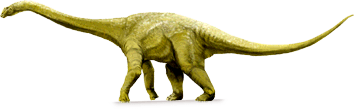
Pronunciation: win-TON-o-TIE-tan
Meaning: Winton Giant
Author/s: Hocknull et al. (2009)
Synonyms: Austrosaurus sp.
First Discovery: Queensland, Australia
Acta Ordinal: #682
Wintonotitan wattsi
Compared to those of similar-sized landmasses, Australia's dinosaur fossil register is a little light on entries, so when a new one turns up it always causes a hubbub, regardless of the quantity of its remains or their state of preservation. And so it was with Wintonotitan (aka "Clancy")—the first Australian sauropod to be named in 75 years—whose remains were originally assigned to Austrosaurus in 1974 because that was the only sauropod known from Oz at the time. Funnily enough, once the Wintanotitan material was formally separated in 2009, Austrosaurus was left so thread-bare that some paleontologists were willing to chalk it off as a "nomen dubium" until better remains presented themselves. Fortunately, present themselves they did.
Found in a billabong along with Diamantinasaurus ("Matilda") and Australovenator ("Banjo"), Wintonotitan was longer but less robust than the former and probably eaten by the latter, and its discovery and other discoveries since have shown that Australia was just as diverse in the Cretaceous sauropod department as any other continent.
Found in a billabong along with Diamantinasaurus ("Matilda") and Australovenator ("Banjo"), Wintonotitan was longer but less robust than the former and probably eaten by the latter, and its discovery and other discoveries since have shown that Australia was just as diverse in the Cretaceous sauropod department as any other continent.
(Watt's Winton Giant)Etymology
Wintonotitan is derived from "Winton" (for the town of Winton) and the Greek "titan" (referring to the giant primordial gods from Greek mythology who ruled Olympus before Zeus and co).
The species epithet, wattsi, honours the late Keith Watts, owner of Elderslie Sheep Station, who discovered the type specimen and donated it to the Queensland Museum.
ZooBank registry: urn:lsid:zoobank.org:act:8C6C2C13-CA79-470E-AC81-54BA5BF0B4A2.
Discovery
The name-bearing remains of Wintonotitan (nicknamed "Clancy" after "Clancy of the Overflow", a poem by A. B. "Banjo" Paterson of Waltzing Matilda fame) were discovered in the Winton Formation at locality QML 313 (the "Triangle Paddock site") on Elderslie Station, approximately 60 km north-west of Winton, central Queensland, Australia, by Keith Watts in 1974.
The holotype (QMF 7292) comprises four partial back vertebrae, rib fragments, four pelvic bones (two vertebrae, a left ilium and ischium), twenty-five tail vertebrae, five chevrons, a partial left shoulder blade, most of both arms, bones from a partial left hand that was originally interpreted as the right (including metacarpal IV, which was described as V and vice versa), and associated bone fragments.
Four tail vertebrae (QM F10916), collected from the Winton Formation on Selwyn Park Sheep Station, south-east of Winton, by Derek J. Fraser on 06/02/1952, were initially identified as the bones of a giant kangaroo, then mislabelled in the Queensland Museum collections as pertaining to a sea-dwelling ichthyosaur. They were correctly identified as the vertebrae of a sauropod and assigned to Austrosaurus sp. by Coombs and Molnar in 1981, then referred to Wintonotitan by Hocknull et al. in 2009.


