




Pronunciation: SAR-gan
Meaning: White monster
Author/s: Norell et al. (2006)
Synonyms: None known
First Discovery: Ömnögovi, Mongolia
Acta Ordinal: #620
Tsaagan mangas
Apart from the odd tooth, Tsaagan mangas own the only "raptor" remains from the Ukhaa Tolgod region of Mongolia, and along with the similarly-sized Velociraptor mongoliensis, was one of only two confirmed dromaeosaurids from the entire Djadokhta Formation, until the discovery of Mahakala in 2007 and a specimen that has yet to be named.
Tsaagan was discovered in 1996 and identified as a specimen of Velociraptor. However, a review of CT scan imagery taken in May 1998 revealed several unique features, including a less pneumatic braincase and much more robust jaws. This led palaeontologists to realise they had a unique critter on their hands, and it was fully described in 2006 by Mark Norell and colleagues, who spelt its name wrong (see etymology).
A 2010 analysis showed that Tsaagan was closely related to Linheraptor exquisitus. The following year, Senter (2011) and a year later still Turner (2012) argued that the pair are more than close relatives: they're the same species, with the latter a junior synonym of the former. In 2015, however, Xu et alLinheraptor that was previously unprepared and lay hidden beneath bone-obscuring rock matrix.
Tsaagan was discovered in 1996 and identified as a specimen of Velociraptor. However, a review of CT scan imagery taken in May 1998 revealed several unique features, including a less pneumatic braincase and much more robust jaws. This led palaeontologists to realise they had a unique critter on their hands, and it was fully described in 2006 by Mark Norell and colleagues, who spelt its name wrong (see etymology).
A 2010 analysis showed that Tsaagan was closely related to Linheraptor exquisitus. The following year, Senter (2011) and a year later still Turner (2012) argued that the pair are more than close relatives: they're the same species, with the latter a junior synonym of the former. In 2015, however, Xu et alLinheraptor that was previously unprepared and lay hidden beneath bone-obscuring rock matrix.
(White Monster)Etymology
In Mongolian, Tsaagan mangas means "White Monster", and refers to a Mongolian driver named Timur who, during a party one night in the desert at Narran Bulag, tried in vain to scare expedition members by covering himself with a white sheet and creeping up on them, pretending to be a ghost (Norell, pers.comm.)
The name, however, is technically a misspelling, as Tsaagan should be Tsagaan, but it's not the first time this has happened. The ankylosaurid Tsagantegia from Tsagaan-Teg (White Mountain) was also spelled wrong, but a different type of wrong, and by different authors.
Discovery
The remains of Tsaagan mangas were discovered in the Djadokhta Formation at the Xanadu sublocality of Ukhaa Tolgod, Ömnögovi (South Gobi) Aimag (Province), Mongolia, in 1996.
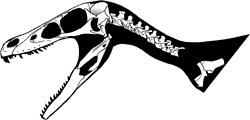
The holotype (IGM 100/1015) is a skull, lower jaw and a series of ten neck vertebrae. A partial left shoulder girdle was preserved in association with the vertebrae.
Preparator
Amy Davidson.


