









Pronunciation: os-MAH-kuh-SOR-us
Meaning: Canyon lizard
Author/s: McDonald (2011)
Synonyms: See below
First Discovery: South Dakota, USA
Acta Ordinal: #769
Osmakasaurus depressus
Along with Uteodon, Osmakasaurus was coined by Andrew McDonald in 2011 during his overhaul of species previously assigned to Camptosaurus.
It was originally named Camptosaurus depressus by Gilmore in 1909, based on USNM 4753, and later reassigned to Planicoxa as Planicoxa depressa by Carpenter and Wilson in 2008. In the intervening years, it was also suspected of belonging to Iguanodon lakotaensis, which Paul renamed Dakotadon in 2008.
On paper, folding USNM 4753 into Dakotadon too would have tied things up neatly, since both hail from the Lakota Formation of South Dakota. In practice, though, the two specimens share no overlapping, well-preserved elements that allow for direct comparison, and thus lack features to positively link one to the other.
Furthermore, USNM 4753 exhibits a unique combination of characters, preventing its assignment to any previously named genus, and so
it ultimately warranted a new one—Osmakasaurus depressus—the depressed Osmaka lizard.
(Depressed Canyon Lizard)
Etymology
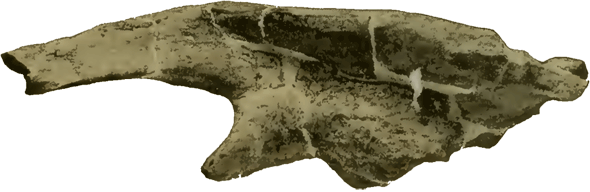
Osmakasaurus is derived from "ósmaka" (meaning "canyon" in the language of the Lakota People, inhabitants of Calico Canyon in western South Dakota where the fossils were found) and the Greek "sauros" (lizard). The species epithet, depressus, was coined by Gilmore in 1909 when its remains were known as Camptosaurus depressus, and refers to the "narrowness or depressed nature of the ilia". Funnily enough, only the left of two ilia, the uppermost and largest bones of the hip, is depressed, and this was probably caused by compressive forces during fossilization.
Camptosaurus depressus (Gilmore, 1909)Planicoxa depressa (Carpenter and Wilson, 2008)
Discovery
The fossils now known as Osmakasaurus were discovered at Calico Canyon in the Chilson Member of the Lakota Formation near Buffalo Gap, Custer County, South Dakota, USA, by Nelson Horatio Darton of the U. S. Geological Survey, in 1896. The holotype (USNM 4753) is a partial skeleton, including a partial pelvic girdle (portions of both ilia, part of the blade of one pubis, and an incomplete sacrum), a partial back vertebra, twelve poorly preserved tail vertebrae, one rib, and many bone fragments. These remains were found associated with the fragmentary skeleton
USNM 4752, described by Dr. Frederic Augustus Lucas as Stegosaurus marshii in 1901, and referred by him to the new genus Hoplitosaurus the following year.
According to Gilmore 1909, "A second specimen. Cat. No. USNM 5820, consisting of the well-preserved anterior portion of a right ilium, collected by Mr. J. L. Kenney from the Morrison beds of the Jurassic, near Como, Albany
County, Wyoming, undoubtedly pertains to this species".
Funnily enough, there's a US steam locomotive with the number 5820. Nicknamed "Big Jim", it was shipped to Poland for the United States Army Transportation Corps during World War II. After a major overhaul starting in 2007, it had a staring role in "The Railway Children Return", and a brief role in the 2019 live action Disney Film "Dumbo". It still runs on the Keighley & Worth Valley Railway in Haworth, Yorkshire, England. There's no link. We just thought you might like to know.


