









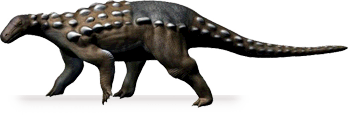
Pronunciation: YOO-ro-PEL-tuh
Meaning: European shield
Author/s: Kirkland et al. (2013)
Synonyms: None known
First Discovery: Teruel, Spain
Acta Ordinal: #873
Europelta carbonensis
Europelta carbonensis was discovered in a century-old open-pit coal mine at Ariño, northeastern Spain, and is the most complete nodosaurid ankylosaur from the entire Cretaceous period of Europe. Nodosaurids had replaced polacanthids as the main armoured dinosaurs in both Europe and North America by the late-Early Cretaceous, with the age of known individuals prompting palaeontologists to suspect that those two continents became separated by rising sea levels during the Barremian (130-125 mya). However, Europelta prompted a re-study of the age of nodosaurids, which pulled the segregation of Europe and America into the Aptian (125-112 mya), after which genera from each side of the pond evolved design quirks relevant to their respective eco-system.
Europelta is the oldest known member of the European branch. It wasn't the first member to be named though, not by a long chalk.
Europe's first named nodosaurid is Austria's Struthiosaurus austriacus, which was coined in 1871 by Emanuel Bunzel, who thought it was a predator and assigned it to a new family, Ornithocephala ("Bird Heads"). It doesn't have a bird's head, but it does, however, sport features in common with Europelta, Anoplosaurus and Hungarosaurus, and the four critters form a Europe-exclusive family of nodosaurids known as the Struthiosaurinae; "the most inclusive clade containing Europelta but not Cedarpelta, Peloroplites, Sauropelta or Edmontonia". It's a travesty that poor old Struthiosaurus doesn't even get a mention in the definition of the clade that bears its name!
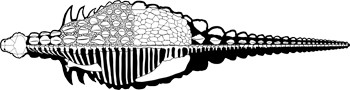 Within Ankylosauria, struthiosaurines are the narrow-snouted, sacral armour-shielded, relatively long and slender-limbed branch of the moderately armoured, medium-sized nodosaurids (Nodosauridae), which are the tail-stiffening-tendon-lacking, clubless brethren of the larger, heavily-armoured ankylosaurids (Ankylosauridae). Dating from the Albian (112-99 mya) of the Early Cretaceous age, Europelta is the oldest known member of Struthiosaurinae and, at five meters long, close to two tons in weight, over a meter tall and almost as wide, by far the largest.
Europe's first named nodosaurid is Austria's Struthiosaurus austriacus, which was coined in 1871 by Emanuel Bunzel, who thought it was a predator and assigned it to a new family, Ornithocephala ("Bird Heads"). It doesn't have a bird's head, but it does, however, sport features in common with Europelta, Anoplosaurus and Hungarosaurus, and the four critters form a Europe-exclusive family of nodosaurids known as the Struthiosaurinae; "the most inclusive clade containing Europelta but not Cedarpelta, Peloroplites, Sauropelta or Edmontonia". It's a travesty that poor old Struthiosaurus doesn't even get a mention in the definition of the clade that bears its name!
Within Ankylosauria, struthiosaurines are the narrow-snouted, sacral armour-shielded, relatively long and slender-limbed branch of the moderately armoured, medium-sized nodosaurids (Nodosauridae), which are the tail-stiffening-tendon-lacking, clubless brethren of the larger, heavily-armoured ankylosaurids (Ankylosauridae). Dating from the Albian (112-99 mya) of the Early Cretaceous age, Europelta is the oldest known member of Struthiosaurinae and, at five meters long, close to two tons in weight, over a meter tall and almost as wide, by far the largest. (Europe's shield, from the coal)Etymology
Europelta is derived from "Euro" (a contraction of Europe, the continent of its discovery) and the Greek "pelte" (shield).
The species epithet, carbonensis, means "from the coal" and refers to the fossil locality in the Santa María coal mine at Ariño, which has been extracting coal since 1919.
ZooBank registry: urn:lsid:zoobank.org:act:62808E3D-85BE-4AE3-B771-9CFF2C6AC054.
Discovery
The remains of Europelta were discovered at the Santa Maria lignite ("brown coal") mine in the Escucha Formation at Ariño in the province of Teruel, Aragon, Spain, in 2011.The holotype (AR-1/10) is a partial skeleton including a mostly complete skull, some teeth, five neck vertebrae (with two ribs), eight back vertebrae (with three ribs plus seven rib fragments), three tail vertebrae, four chevrons, shoulder bones, two partial upper arm bones, and a complete pelvis. A second, somewhat smaller specimen (AR-1/10) was discovered around 200m from the first.


