









Pronunciation: ba-LAH-wuhr
Meaning: Stocky dragon
Author/s: Csiki et al. (2010)
Synonyms: None known
First Discovery: Sebes, Romania
Acta Ordinal: #709
Balaur bondoc
The first remains of what would become Balaur bondoc—discovered in 1997 by Dan Grigorescu—was a jigsaw of arm bones that palaeontologists struggled to put together but eventually (and mistakenly) identified as the property of an oviraptorosaur. With the discovery of matching remains and more, including oddly wrinkle-textured bones by Mátyás Vremir of the Transylvanian Museum Society of Cluj-Napoca in September 2009, it was clear that the critter in question wasn't an oviraptorosaur at all but a dromaeosaurid related to the limelight hogging Velociraptor of dirty stinkin' Jurassic Park fame. But it was much awesomer. Yes, awesomer.
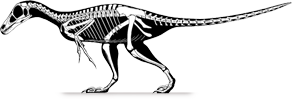
Otherwise unknown among derived coelurosaurian theropods, many of the bones in Balaur's unusually small hands were fused, and it lacked a third finger, so it wasn't one for grasping. Its short and stocky feet and legs suggest it wasn't one for running either. However, huge muscle attachment areas on the pelvis for strength combined with twice the going rate of hindlimb "killing claws" seem to suggest that Balaur was well equipped to give its prey a good old-fashioned kicking. You see? Awesomer.
Like the modern Galapagos Islands with their flightless cormorants and swimming iguanas, weird critters abound on the ancient island of Hateg (pronounced Hat-zeg), as isolation played havoc with the inhabitants. The "Island Rule" (aka insular dwarfism) — a century-old theory first wheeled out by Hungarian explorer, King of Albania wannabe, weapons smuggler, bi-sexual biker and palaeontologist extraordinaire Franz Nopcsa — was one of the possible side-effects, with limited island resources resulting in the likes of Magyarosaurus (a sauropod), Telmatosaurus and Zalmoxes (both ornithopods) being "allowed" to grow to only a fraction the size of their mainland counterparts.
Balaur, on the other hand, was of similar size but a bit chunkier than its closest relatives, which, funnily enough, are from Asia. In fact, by process of elimination, Balaur may have been the largest predatory dinosaur in its ecosystem (despite measuring only two meters in length) because, in over a hundred years of research, Romania has not yielded a larger theropod.
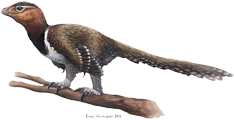 2015 research by Cau et al., who referred to Balaur as "Dodoraptor", had it pegged as closer to modern birds than other dromaeosaurids. In fact, in a bizarre twist, it may actually be a weird, herbivorous, flightless bird, with
its robust first toe being used for weight support rather than a weapon and a swept-back pubis making room for a pot belly to digest vegetation, much like therizinosaurids.
2015 research by Cau et al., who referred to Balaur as "Dodoraptor", had it pegged as closer to modern birds than other dromaeosaurids. In fact, in a bizarre twist, it may actually be a weird, herbivorous, flightless bird, with
its robust first toe being used for weight support rather than a weapon and a swept-back pubis making room for a pot belly to digest vegetation, much like therizinosaurids.
Otherwise unknown among derived coelurosaurian theropods, many of the bones in Balaur's unusually small hands were fused, and it lacked a third finger, so it wasn't one for grasping. Its short and stocky feet and legs suggest it wasn't one for running either. However, huge muscle attachment areas on the pelvis for strength combined with twice the going rate of hindlimb "killing claws" seem to suggest that Balaur was well equipped to give its prey a good old-fashioned kicking. You see? Awesomer.
Like the modern Galapagos Islands with their flightless cormorants and swimming iguanas, weird critters abound on the ancient island of Hateg (pronounced Hat-zeg), as isolation played havoc with the inhabitants. The "Island Rule" (aka insular dwarfism) — a century-old theory first wheeled out by Hungarian explorer, King of Albania wannabe, weapons smuggler, bi-sexual biker and palaeontologist extraordinaire Franz Nopcsa — was one of the possible side-effects, with limited island resources resulting in the likes of Magyarosaurus (a sauropod), Telmatosaurus and Zalmoxes (both ornithopods) being "allowed" to grow to only a fraction the size of their mainland counterparts.
Balaur, on the other hand, was of similar size but a bit chunkier than its closest relatives, which, funnily enough, are from Asia. In fact, by process of elimination, Balaur may have been the largest predatory dinosaur in its ecosystem (despite measuring only two meters in length) because, in over a hundred years of research, Romania has not yielded a larger theropod.
2015 research by Cau et al., who referred to Balaur as "Dodoraptor", had it pegged as closer to modern birds than other dromaeosaurids. In fact, in a bizarre twist, it may actually be a weird, herbivorous, flightless bird, with
its robust first toe being used for weight support rather than a weapon and a swept-back pubis making room for a pot belly to digest vegetation, much like therizinosaurids.
(Stocky dragon)
Etymology
Balaur is an archaic Romanian term that designates a mythical dragon-like
creature. In lamens terms, it means "dragon".The species epithet, bondoc (pronounced like "boned oak"), literally means "squat and chubby" or possibly "runt" in Romanian. The authors specify "stocky" in reference to the small but robust build of the animal, which sounds much better.
Discovery
The first remains of Balaur were discovered in red floodplain mudstones
of the Sebes Formation, 2.5 km north of Sebes
town, alongside the Sebes River in Alba County, Romania. The specimen
was collected by Mátyás Vremir in September 2009 and given
a preliminary field number (SbG/A-Sk1) during collection and preparation.
The holotype (EME VP.313) is a partial skeleton including leg, hip, back, arm, hand, rib, and tail bones.
Referred remains (catalogued as FGGUB R. 1580-1585), from a 45% larger specimen, were discovered about 100 km from the type locality at the Tustea dinosaur nesting site in the Densus-Ciula Formation, near Tustea village, Hunedoara County, Hateg Basin, Romania, by Dan Grigorescu of the University of Bucharest in 1997, though some palaeontologists suspect that they may belong to a different species.


